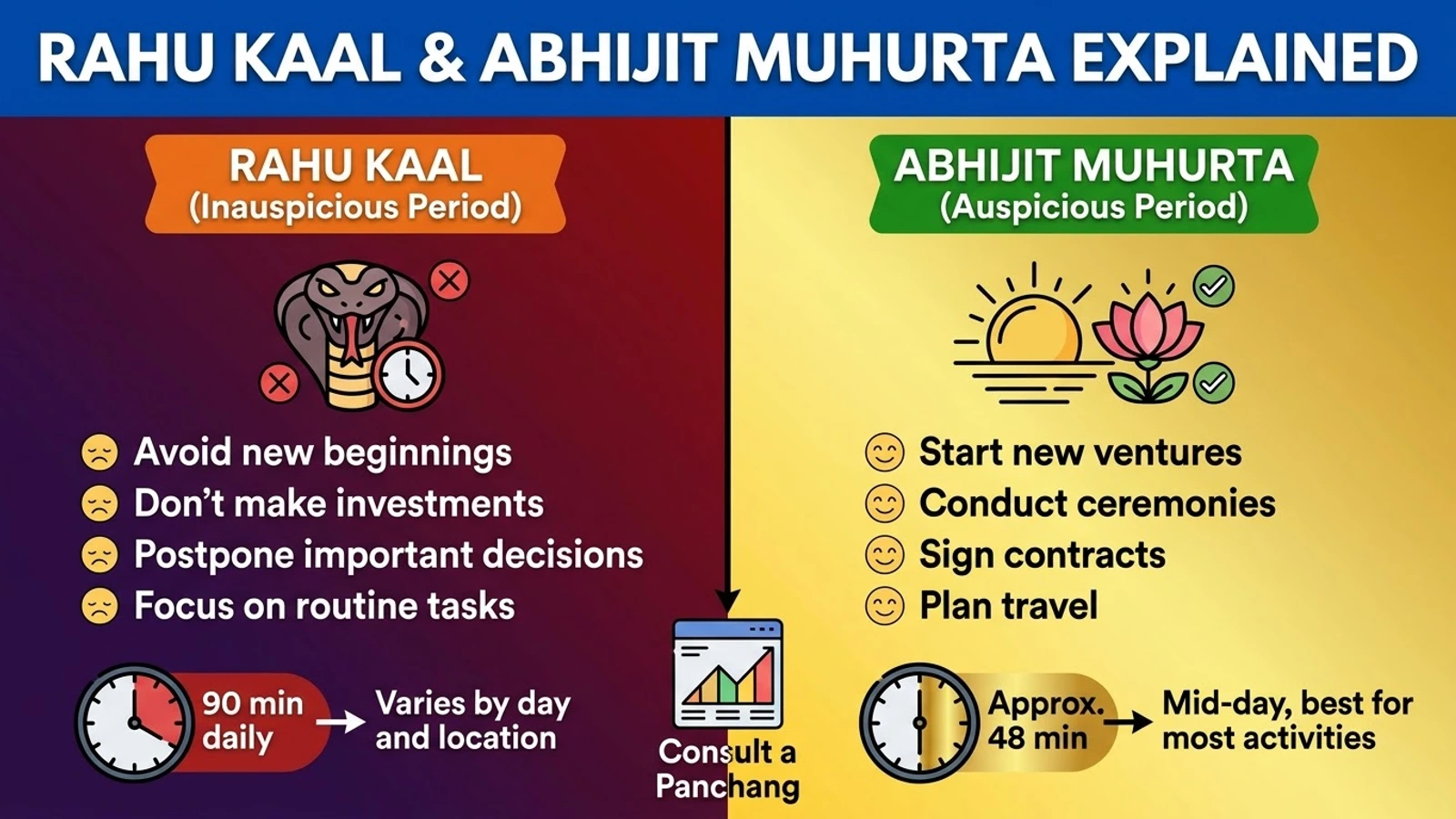
Search "Rahu Kaal today" and you'll find tables listing a clock time for each weekday, but those tables are only ever approximations for one reference city. Both Rahu Kaal and Abhijit Muhurta are defined relative to sunrise and sunset, not the clock, which is why the real timing shifts by date, by season, and by exactly where you are.
Rahu Kaal: an eighth of the day, by weekday
Panchang tradition divides the daylight interval (sunrise to sunset) into eight equal segments. Which of those eight segments counts as Rahu Kaal depends on the day of the week, following a fixed traditional order (for example, Monday's Rahu Kaal falls in the second segment of the day, Saturday's in the third). Because day length itself varies by season and latitude, each segment's actual clock duration, and so Rahu Kaal's real start and end time, is different in every city and changes through the year. It's traditionally treated as an inauspicious window for starting something new.
Gulika Kaal and Yamaganda Kaal
Rahu Kaal isn't the only shadow period computed this way: Gulika Kaal and Yamaganda Kaal are calculated on the same eight-segment logic, just assigned to different segments by weekday, and are traditionally checked alongside Rahu Kaal when picking a Muhurta (auspicious window) for something important.
Abhijit Muhurta: the day's most favored window
Where Rahu Kaal marks an unfavorable stretch, Abhijit Muhurta marks a favored one. The daylight interval is divided into 15 Muhurtas of roughly 48 minutes each on a standard 12-hour day; the 8th of these, centered on local solar noon, is Abhijit, traditionally considered auspicious enough to override lesser inauspicious influences at that moment. By convention, most Panchang systems exclude Abhijit Muhurta on Wednesdays.
Why two Panchang sites can disagree
Beyond the ayanamsha used, the biggest source of disagreement between Panchang sources is how precisely sunrise and sunset are computed for the specific location. A table built for one reference city, applied nationwide, will be off everywhere else, sometimes by enough to shift which segment Rahu Kaal actually falls in.
Get today's timings for your city
See Rahu Kaal, Gulika Kaal, Yamaganda Kaal, and Abhijit Muhurta computed live from the Swiss Ephemeris for your own location in today's Panchang.