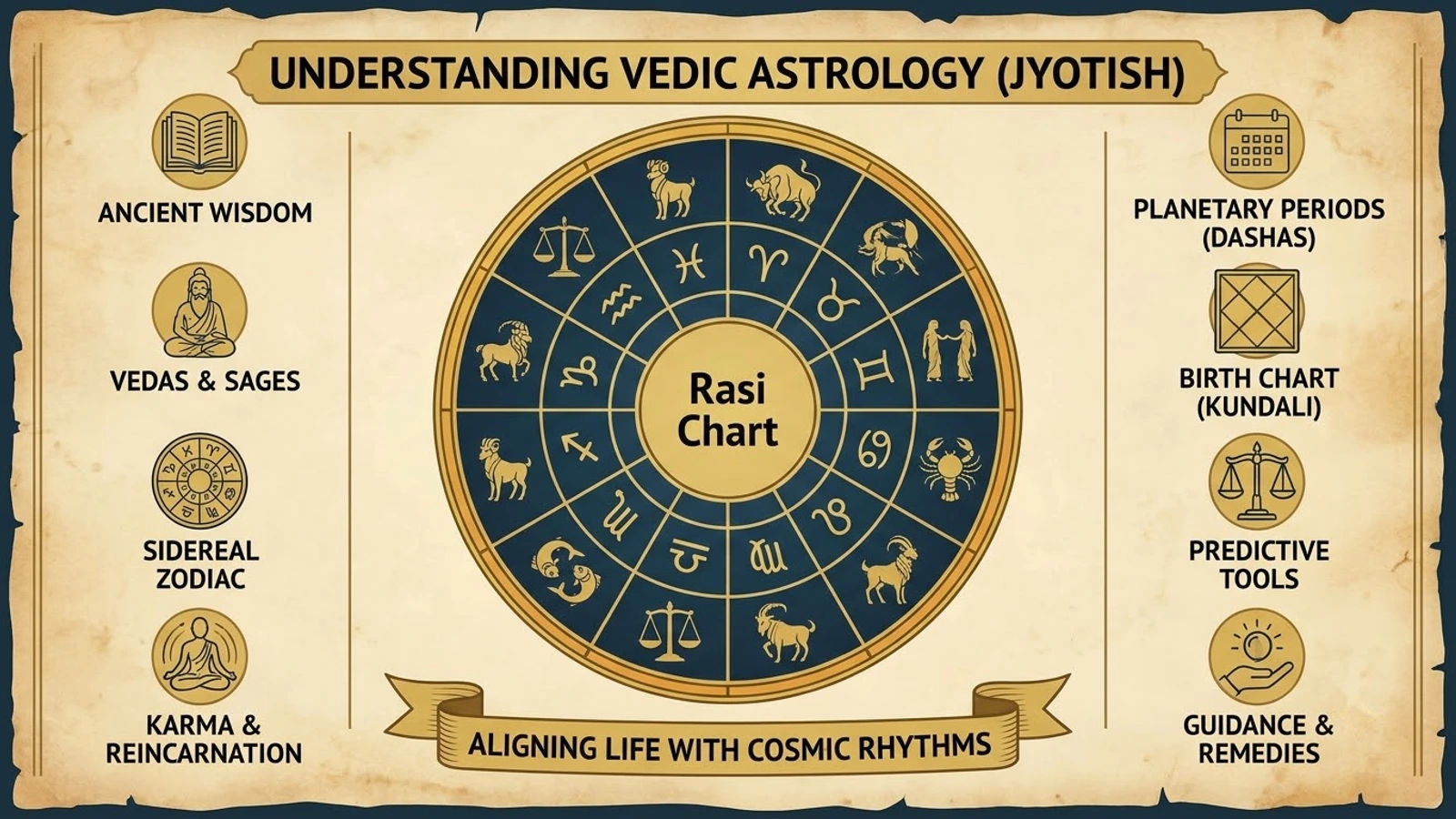
Vedic astrology is the traditional astrology of India, known in Sanskrit as Jyotisha, "the knowledge of light". It reads a chart of the sky at the moment and place you were born, using the stars rather than the seasons as its reference, and it has its own way of timing life: the Dasha system. Millions of families still use it to name children, time weddings and think through big decisions.
Where the name comes from
Jyotisha is built from jyoti, light, and refers to the study of the heavenly lights. In the classical scheme it is one of the six Vedangas, the "limbs" of knowledge that support the Vedas, alongside phonetics, metre, grammar, etymology and ritual procedure.
Its original job was practical. Vedic rituals had to be performed at the right lunar day and season, so early Jyotisha was largely calendar science: tracking the Sun, the Moon and the Nakshatras to keep time. The oldest surviving text, the Vedanga Jyotisha, is essentially a manual for doing that.
Reading an individual's birth chart came later. Historians trace a major step to the early centuries CE, when Greek-language astrology reached western India; the Yavanajataka ("the horoscopy of the Greeks") is the best-known record of that exchange. Indian astronomers and astrologers then developed the tradition in their own direction, adding the Nakshatras, the Dasha systems and a large body of original technique. Many practitioners regard Jyotisha as far older and as part of revealed Vedic knowledge. Both views are held sincerely, and you'll meet both.
The three branches of Jyotisha
Classical writers divided the subject into three parts. It helps to know them, because "Vedic astrology" usually means only the third.
| Branch | Concerned with | Example |
|---|---|---|
| Siddhanta | Astronomy and calculation | Computing planetary positions and eclipses |
| Samhita | Collective and worldly matters | Weather, harvests, omens, even building layouts |
| Hora | The individual | Reading a person's birth chart |
The Samhita branch is broader than people expect. Varahamihira's sixth-century Brihat Samhita includes chapters on architecture and house sites, one reason Jyotisha and Vastu Shastra have always sat close together.
The key texts
A few works come up again and again:
- Brihat Parashara Hora Shastra, attributed to the sage Parashara. It is the foundation of the Parashari school most modern astrologers follow, though the text as we have it was compiled much later and its date is debated.
- Brihat Jataka by Varahamihira, a concise and influential sixth-century text on natal astrology.
- Jaimini Sutras, the basis of the Jaimini system, with its own methods for timing and for significators such as the Atmakaraka.
- Later works such as Saravali and Phaladeepika, which many astrologers read alongside the classics.
These texts don't always agree. Part of reading Vedic astrology well is knowing which school a rule comes from.
The sidereal zodiac, and why your sign may change
The most visible difference from Western astrology is the zodiac itself. Most Western astrology uses the tropical zodiac, which starts Aries at the spring equinox and is tied to the seasons. Vedic astrology uses the sidereal zodiac, which is tied to the actual background stars.
Because the Earth's axis slowly wobbles (precession), the two zodiacs drift apart by about one degree every 72 years. Today the gap, called the ayanamsa, is a little over 24 degrees. A planet at 10° Taurus in a Western chart sits at about 16° Aries in a Vedic one. That is why many people discover their "Vedic sign" is the one before the sign they grew up with. Our guide to Rashi vs Sun sign walks through this in detail.
Different traditions compute the ayanamsa slightly differently. The Lahiri (Chitrapaksha) value, recommended by India's Calendar Reform Committee in the 1950s, is the most widely used, and it's the one Aroha uses.
The building blocks of a chart
A Vedic birth chart, or Kundli, is assembled from a handful of components.
| Component | How many | What it represents |
|---|---|---|
| Grahas (planets) | 9 | Sun, Moon, Mars, Mercury, Jupiter, Venus, Saturn, and the lunar nodes Rahu and Ketu |
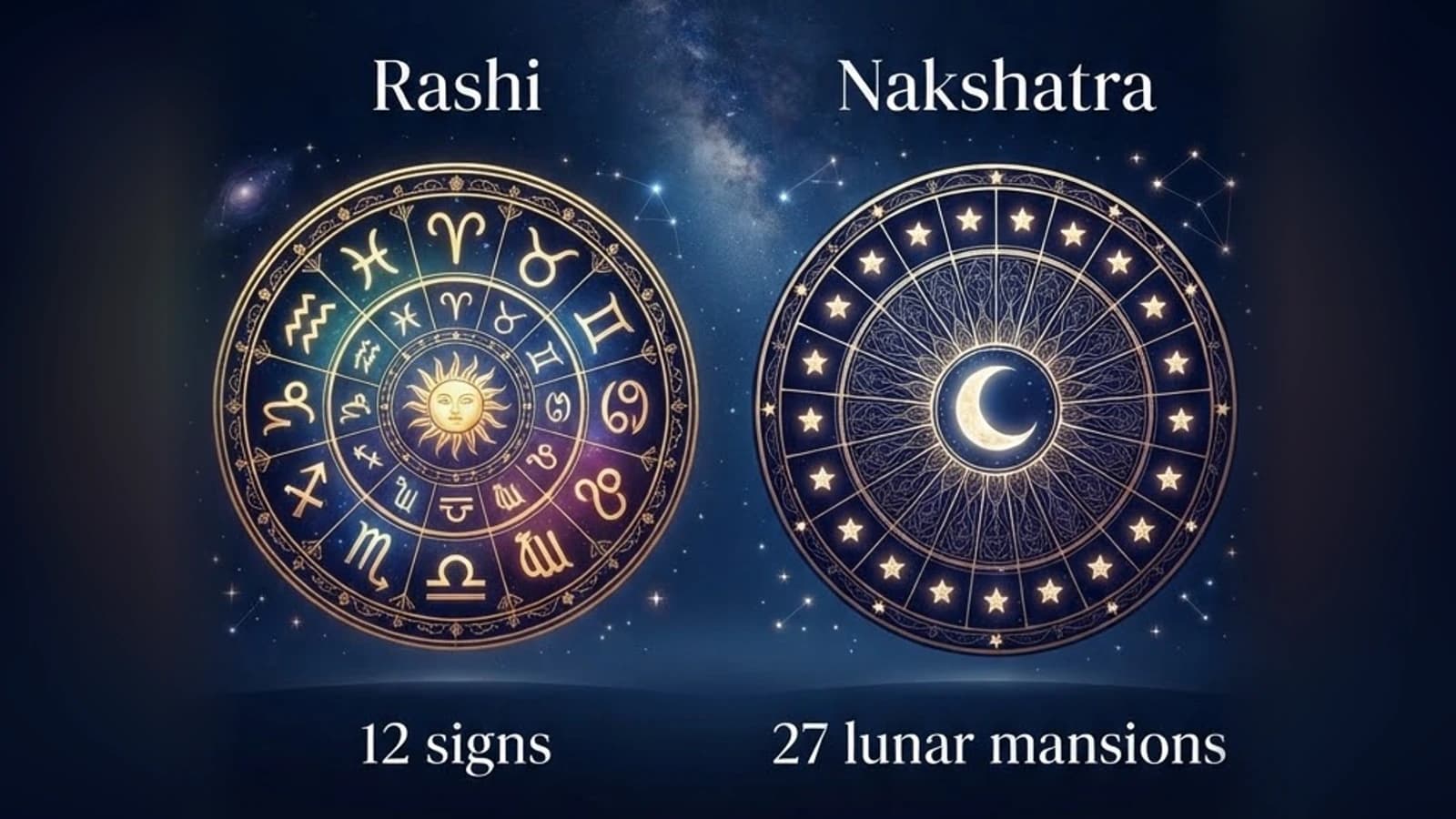
| Rashis (signs) | 12 | The 30° divisions of the zodiac |
| Bhavas (houses) | 12 | Areas of life, counted from the Ascendant |
| Nakshatras | 27 | Lunar mansions of 13°20′ each |
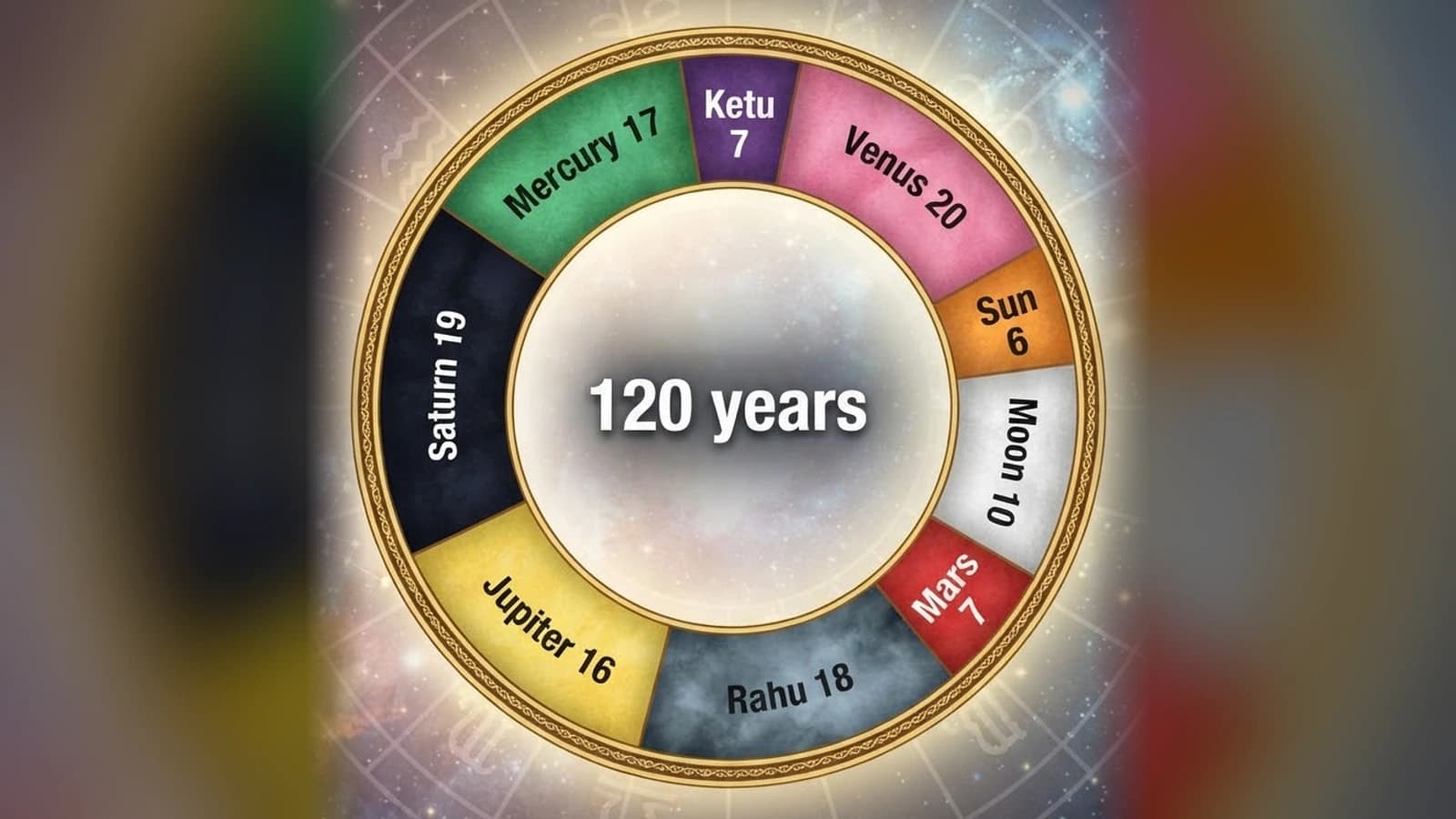
| Dashas | 9 periods | The timeline, usually the 120-year Vimshottari cycle |
| Yogas | Many | Planetary combinations with traditional meanings |
| Vargas | Up to 16 or more | Divisional charts such as the Navamsa (D9) |
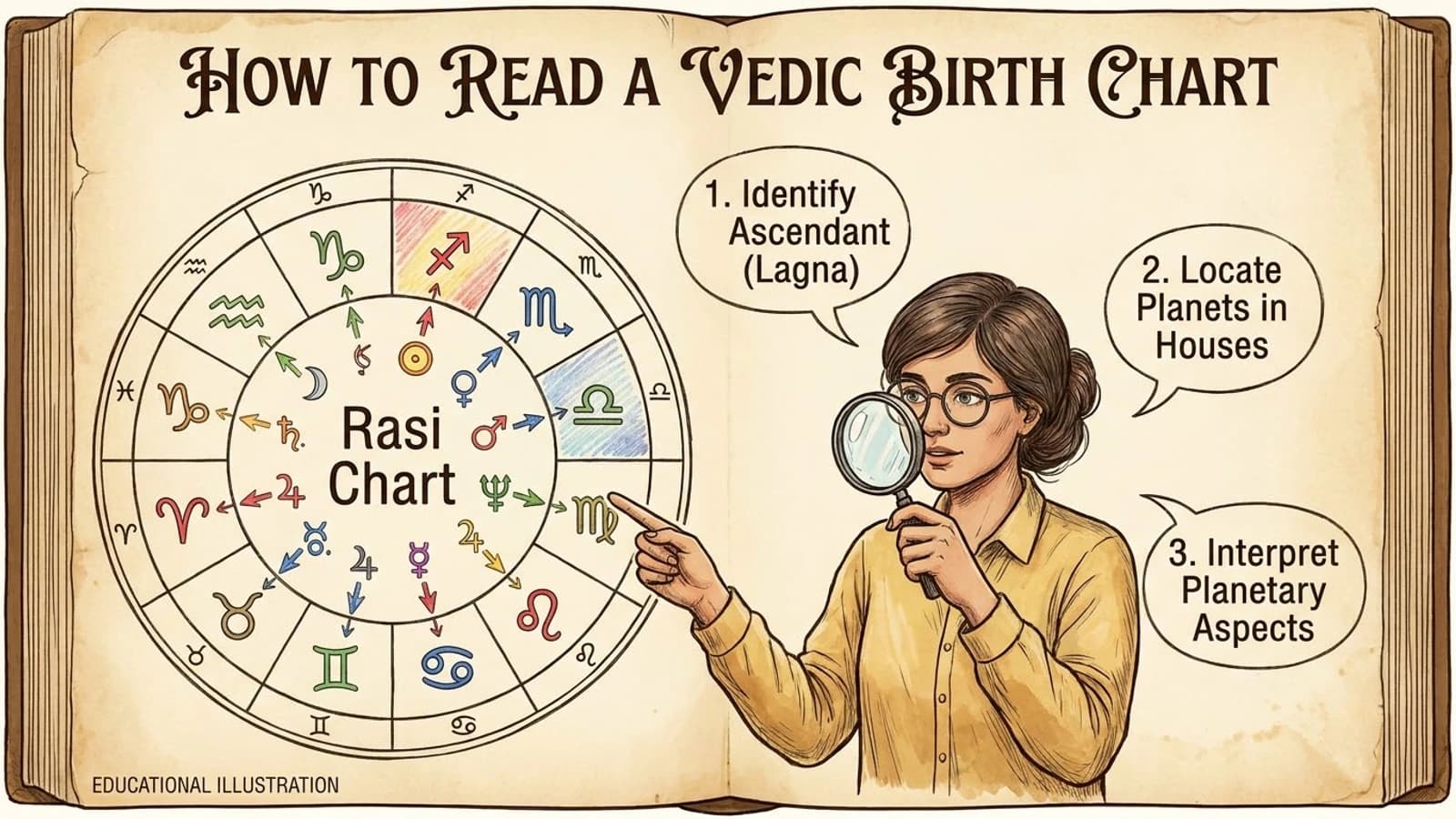
Two points carry special weight. The Lagna (Ascendant), the sign rising on the eastern horizon at birth, fixes the whole house structure; see What is Lagna. And the Moon is treated as the mind: your Moon sign and its Nakshatra drive the Dasha calculation and most daily horoscopes.
Timing: what makes Vedic astrology distinctive
If one feature sets Vedic astrology apart, it's the Dasha system. Rather than reading only where planets are now, it divides a life into planetary periods. In the most common system, Vimshottari Dasha, the nine grahas take turns over a 120-year cycle, and your starting point is fixed by the Nakshatra your Moon occupied at birth.
Each period is read through that planet's condition in your chart. An astrologer then layers current planetary movement, called transits or gochar, on top of the Dasha to describe the tone of a particular stretch of time.
How a chart is read, in brief
Every astrologer has a method, but most readings follow a similar order:
- The Lagna and its lord: the frame of the whole chart.
- Each house: which sign it holds, which planets sit in it, and where its ruling planet has gone.
- Planetary strength: dignity (exalted, own sign, debilitated), aspects, combustion, retrogression.
- Yogas: recognised combinations, from Raj Yoga to doshas.
- Divisional charts: the Navamsa for marriage and inner strength, the Dasamsa for career, and others.
- Timing: the running Dasha and major transits.
Our step-by-step guide on how to read a birth chart goes further.
Vedic and Western astrology compared
| Vedic (Jyotish) | Most Western astrology | |
|---|---|---|
| Zodiac | Sidereal (star-based) | Tropical (season-based) |
| Emphasis | Ascendant and Moon | Sun sign |
| Planets used | Seven visible planets plus Rahu and Ketu | Adds Uranus, Neptune, Pluto |
| Timing | Dasha periods plus transits | Transits, progressions |
| Aspects | Whole-sign, with special aspects for Mars, Jupiter and Saturn | Exact angles with orbs |
| Lunar mansions | 27 Nakshatras, central | Rarely used |
Neither system is simply "right". They measure from different reference points and grew out of different histories.
What Vedic astrology can and can't tell you
The astronomy behind a chart is exact: where each planet was, to a fraction of a degree, is simple arithmetic. Interpretation is different. Controlled studies of astrology have not found that it predicts personality or events better than chance, and there is no known physical mechanism for it to do so.
What many people value in Vedic astrology is not certainty but a structured way to reflect: a language for talking about temperament, relationships and timing, drawn from a long tradition. Used that way, it can be meaningful. Used as a verdict, and especially as a reason for fear or for costly remedies, it causes harm. No chart should replace medical, legal or financial advice.
A good rule: any reading that tells you something terrible will happen unless you pay for a remedy is not a reading worth trusting.
Where to begin
If you're new, start small:
- Find your exact birth time. A birth certificate or hospital record is best. If you don't have it, see how to find an unknown birth time.
- Generate your Kundli. Aroha's free Kundli shows your Lagna, houses and planetary positions.
- Learn three things first: your Lagna, your Moon sign and your Moon's Nakshatra. Most of Vedic astrology builds on those.
- Then look at timing: which Mahadasha you're in, and what its planet is doing in your chart.
From there, the rest of this Knowledge Hub is organised so each concept builds on the last.