Open a Hindu calendar and every date comes with a short line of Sanskrit terms: Shukla Ekadashi, Budhavara, Rohini, Siddha, Bava. That line is the Panchang of the day. Panch-anga means "five limbs", and those five measurements, taken together, describe the character of a day in the traditional calendar.
- 01
Tithi
Lunar day
Each 12° the Moon moves ahead of the Sun
- 02
Vara
Weekday
Counted from sunrise to sunrise
- 03
Nakshatra
Lunar mansion
The Moon’s position among the 27
- 04
Yoga
Sun–Moon combination
Their added longitudes, in 13°20′ steps
- 05
Karana
Half a Tithi
Every 6° of Sun–Moon separation
1. Tithi: the lunar day
The Tithi is the heart of the Hindu calendar. It measures how far the Moon has moved ahead of the Sun: every 12° of separation is one Tithi, so a full cycle from new moon to new moon contains 30 Tithis.
They are split into two fortnights, or pakshas:
- Shukla Paksha, the bright or waxing fortnight, from the new moon to the full moon.
- Krishna Paksha, the dark or waning fortnight, from the full moon back to the new moon.
| Tithi | Name | Tithi | Name |
|---|---|---|---|
| 1 | Pratipada | 9 | Navami |
| 2 | Dwitiya | 10 | Dashami |
| 3 | Tritiya | 11 | Ekadashi |
| 4 | Chaturthi | 12 | Dwadashi |
| 5 | Panchami | 13 | Trayodashi |
| 6 | Shashthi | 14 | Chaturdashi |
| 7 | Saptami | 15 | Purnima (full moon) or Amavasya (new moon) |
| 8 | Ashtami |
Because the Moon's speed varies, a Tithi can last anywhere from about 19 to 26 hours. Occasionally a Tithi begins and ends between two sunrises and is "skipped" in the calendar, or spans two sunrises and appears twice. This is why a festival sometimes seems to move by a day between calendars.
Most festivals are fixed by Tithi: Ganesh Chaturthi on Shukla Chaturthi of Bhadrapada, Janmashtami on Krishna Ashtami, Diwali on the new moon (Amavasya) that falls in Ashvin or Kartika, depending on the regional calendar. Ekadashi, the eleventh Tithi of each fortnight, is widely observed as a fasting day.
2. Vara: the weekday
The Vara is the familiar seven-day week, but in the Panchang each day runs from sunrise to sunrise, not midnight to midnight. Each Vara is named for a planet:
| Vara | Day | Planet |
|---|---|---|
| Ravivara | Sunday | Sun |
| Somavara | Monday | Moon |
| Mangalavara | Tuesday | Mars |
| Budhavara | Wednesday | Mercury |
| Guruvara | Thursday | Jupiter |
| Shukravara | Friday | Venus |
| Shanivara | Saturday | Saturn |
The same planet-to-day sequence appears across many cultures, which is why "Saturday" and "Shanivara" both belong to Saturn.
3. Nakshatra: the Moon's mansion
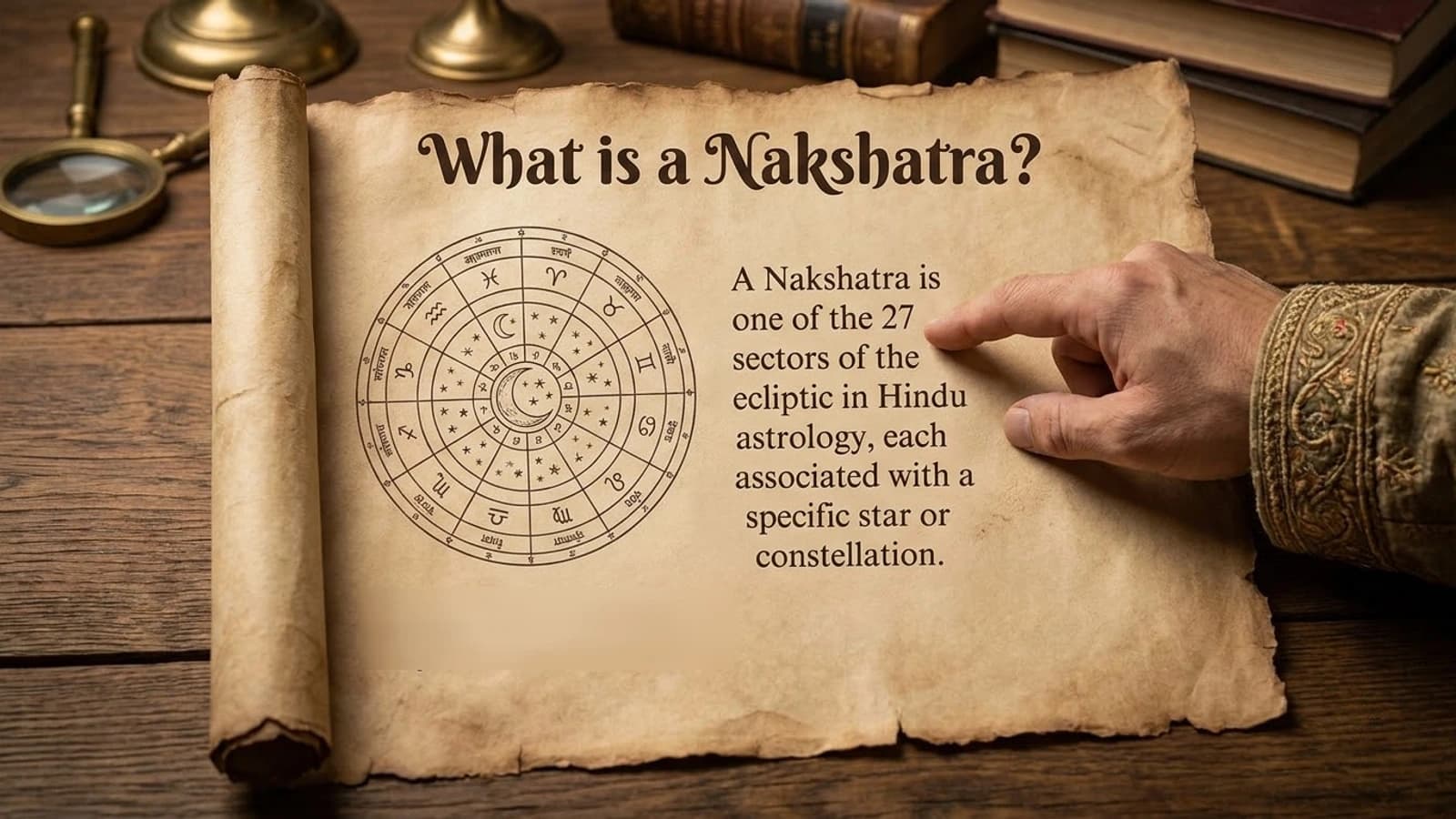
The third limb is the Nakshatra the Moon is passing through, one of 27 segments of 13°20′. The Moon spends roughly a day in each. The day's Nakshatra matters most in Muhurta, the choice of auspicious times: many traditions prefer particular Nakshatras for weddings, housewarmings or starting a journey. Our list of the 27 Nakshatras gives each one's ruler and deity.
4. Yoga: the Sun-Moon combination
This Yoga is different from the planetary yogas in a birth chart. Here, the longitudes of the Sun and Moon are added together, and the total is divided into 27 segments of 13°20′. Each segment has a name:
Vishkambha, Priti, Ayushman, Saubhagya, Shobhana, Atiganda, Sukarma, Dhriti, Shoola, Ganda, Vriddhi, Dhruva, Vyaghata, Harshana, Vajra, Siddhi, Vyatipata, Variyan, Parigha, Shiva, Siddha, Sadhya, Shubha, Shukla, Brahma, Indra and Vaidhriti.
Tradition classes a few, such as Vyatipata and Vaidhriti, as inauspicious for beginning important work, and many others as favourable.
5. Karana: half a Tithi
A Karana is half a Tithi, or 6° of Sun-Moon separation, so there are 60 in a lunar month. There are only 11 Karana names:
- Seven movable Karanas that repeat in sequence through the month: Bava, Balava, Kaulava, Taitila, Gara, Vanija and Vishti.
- Four fixed Karanas that occur once each around the new moon: Shakuni, Chatushpada, Naga and Kimstughna.
Vishti, also called Bhadra, is traditionally avoided for auspicious beginnings.
Beyond the five limbs
A modern Panchang usually adds daily timings calculated from local sunrise and sunset:
- Sunrise, sunset, moonrise and moonset.
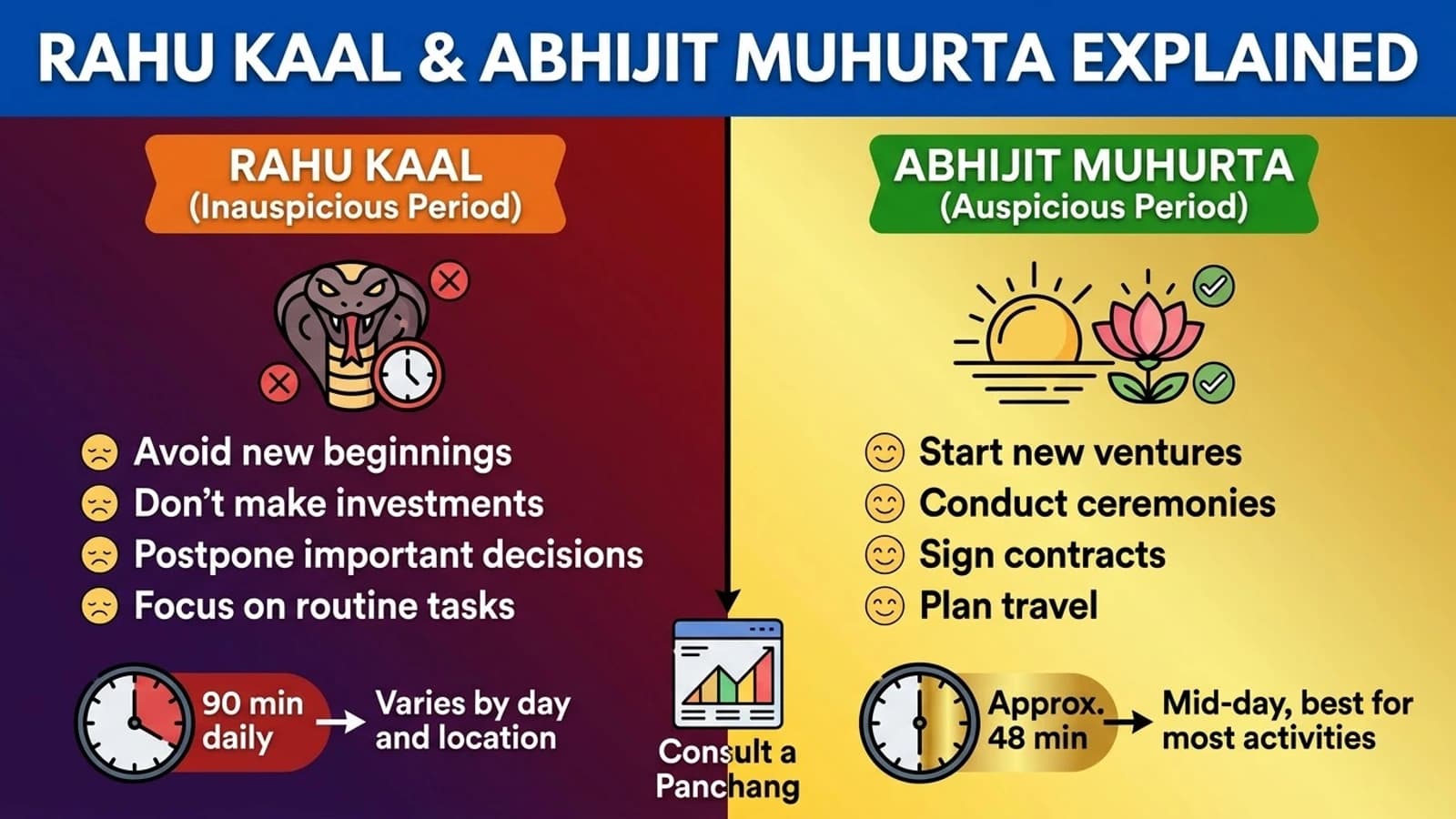
- Rahu Kaal, Yamaganda and Gulika Kaal: segments of the day traditionally avoided for new ventures.
- Abhijit Muhurta: the period around local noon, traditionally considered favourable.
- Choghadiya: eight daytime and eight night-time periods, popular in western India.
Our guide to Rahu Kaal and Abhijit Muhurta explains how these are worked out.
Amanta and Purnimanta: two ways to count a month
Indian calendars also differ in where a month ends. In the Amanta system, followed widely in south and west India, a month ends at the new moon. In the Purnimanta system, common in north India, it ends at the full moon. The Tithis are identical, but the month name attached to the dark fortnight differs. That is why some festivals appear to fall in different months in different regional calendars even though they're celebrated on the same day.
How people use a Panchang
- Festivals and fasts. Knowing the Tithi tells you when Ekadashi, Purnima or a festival falls.
- Choosing a date. Families consult the Panchang, often with a priest or astrologer, when setting a date for a wedding, a Griha Pravesh or another ceremony.
- Planning the day. Some people simply check Rahu Kaal before starting something new.
The Panchang is a traditional framework for marking time; how much weight to give it is a personal and family choice. Its astronomy is exact, and its judgements of "auspicious" and "inauspicious" come from the tradition.
Reading today's Panchang
Aroha's Panchang page shows today's Tithi, Nakshatra, Yoga, Karana, Vara, sunrise, sunset and Rahu Kaal, computed with the Swiss Ephemeris. The Aroha Astrology app recalculates them for your own city, and adds the Abhijit Muhurta and an hour-by-hour Choghadiya.
What the video shows
Is today the right day? The app shows the five limbs of the day (Tithi, Vaar, Nakshatra, Yoga and Karana), today’s Tithi (Shukla Chaturdashi, ending at 23:08 before Purnima), when to wait and when to begin with Rahu Kaal and Abhijit Muhurta, and every hour of the day rated in the Choghadiya. Aroha Astrology: today’s Panchang, for your city. Free on Android and the web.