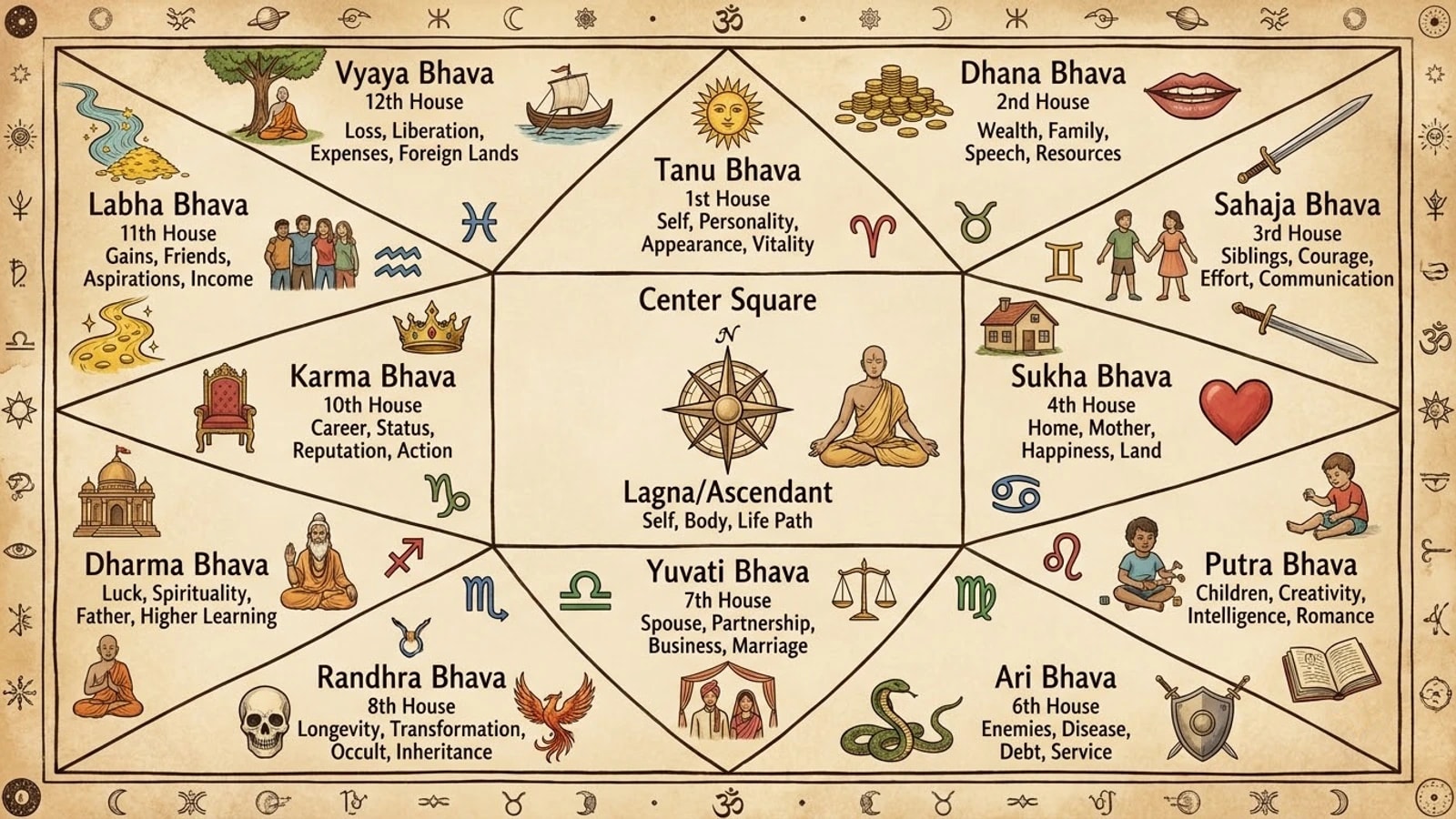
If the Lagna is the starting point of your birth chart, the 12 houses (bhavas) are the map it's drawn on. Every planet in your chart sits in exactly one house, and which house it's in changes what that planet is actually talking about in your life.
The 12 houses, one by one
- 1st, Tanu Bhava: self, body, personality
- 2nd, Dhana Bhava: wealth, family, speech
- 3rd, Sahaja Bhava: courage, siblings, communication
- 4th, Sukha Bhava: home, mother, property
- 5th, Putra Bhava: intelligence, creativity, children
- 6th, Ripu/Roga Bhava: competition, debts, disease
- 7th, Kalatra Bhava: marriage, partnerships
- 8th, Ayu Bhava: transformation, longevity, hidden matters
- 9th, Dharma/Bhagya Bhava: fortune, dharma, higher learning
- 10th, Karma Bhava: career, profession, status
- 11th, Labha Bhava: gains, income, networks
- 12th, Vyaya Bhava: expenditure, isolation, foreign lands
A planet's placement in one of these houses tells you where in your life its themes tend to show up. Jupiter in the 10th house, for instance, is read very differently from Jupiter in the 12th. Same planet, different arena.
Kendra houses
The 1st, 4th, 7th and 10th houses are the Kendras, or angular houses. They form the structural backbone of the chart, and planets placed here, or ruling here, are generally considered to gain strength and prominence.
Trikona houses
The 1st, 5th and 9th houses are the Trikonas, or trine houses, traditionally associated with fortune, merit and auspiciousness. The 1st house belongs to both groups, which is part of why the Lagna carries so much weight in a chart reading.
Dusthana houses
The 6th, 8th and 12th houses are the Dusthanas, houses tied to struggle, loss, transformation and endings. They are where a chart's harder lessons and turning points tend to concentrate, and they're read carefully rather than dismissed.
Upachaya houses
The 3rd, 6th, 10th and 11th houses are the Upachayas, or "growth" houses, areas of life that traditionally tend to improve with effort and time, even when a planet placed there starts out weak.
Why the same planet behaves differently in different houses
This is the core reason houses matter as much as signs and planets: a planet's basic nature doesn't change from chart to chart, but its house placement determines which part of your life it's actively influencing. Venus in the 7th speaks to partnership in a very direct way; Venus in the 2nd speaks more to wealth, family and speech. Understanding the house system is what turns "I have strong Jupiter" into an actual, specific reading of your life.
See your own houses
Every planet, house cusp and lordship in your chart is calculated the moment you generate a Kundli. Get your free Kundli with Aroha Astrology and see exactly which house each of your planets falls in.