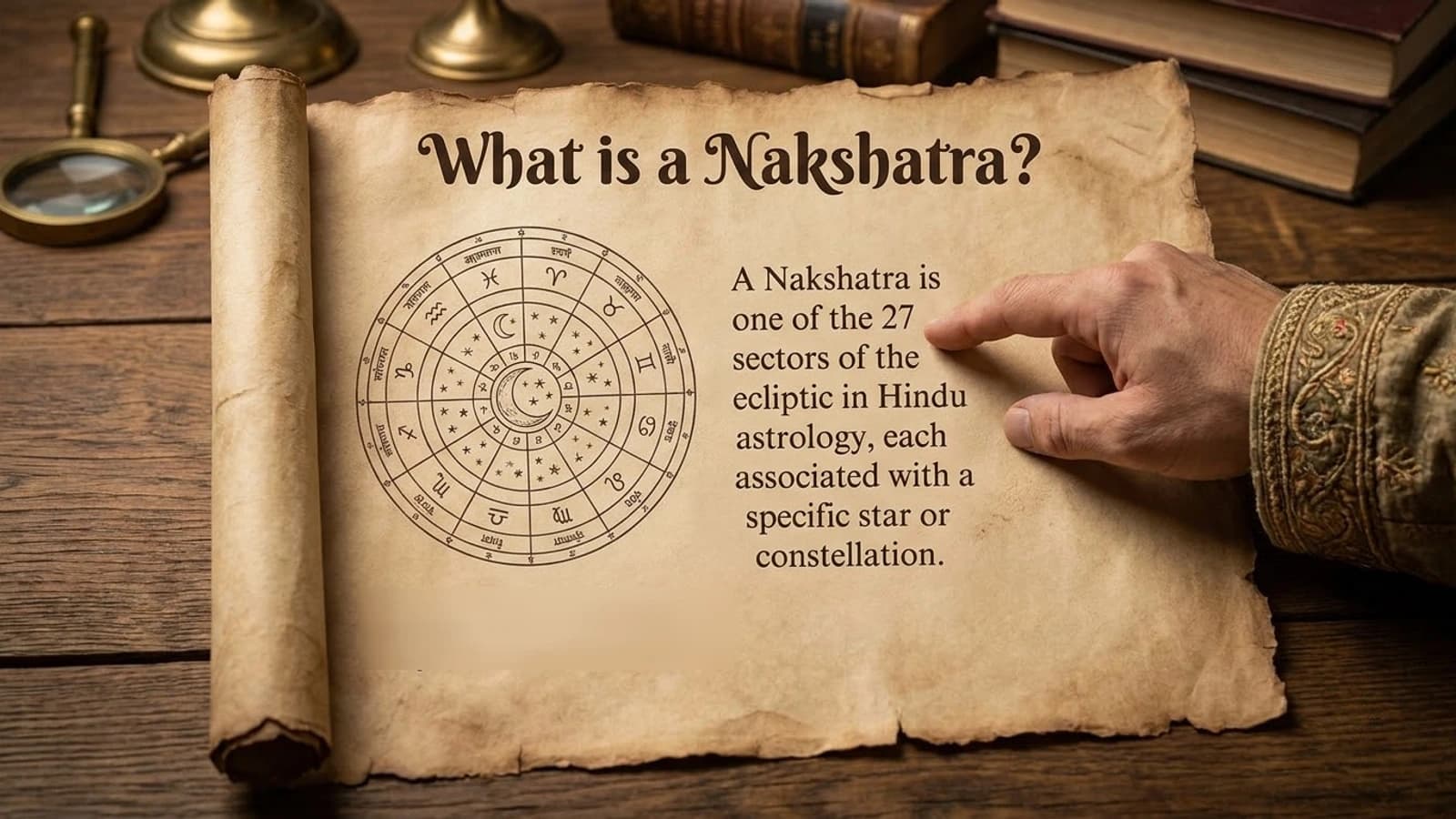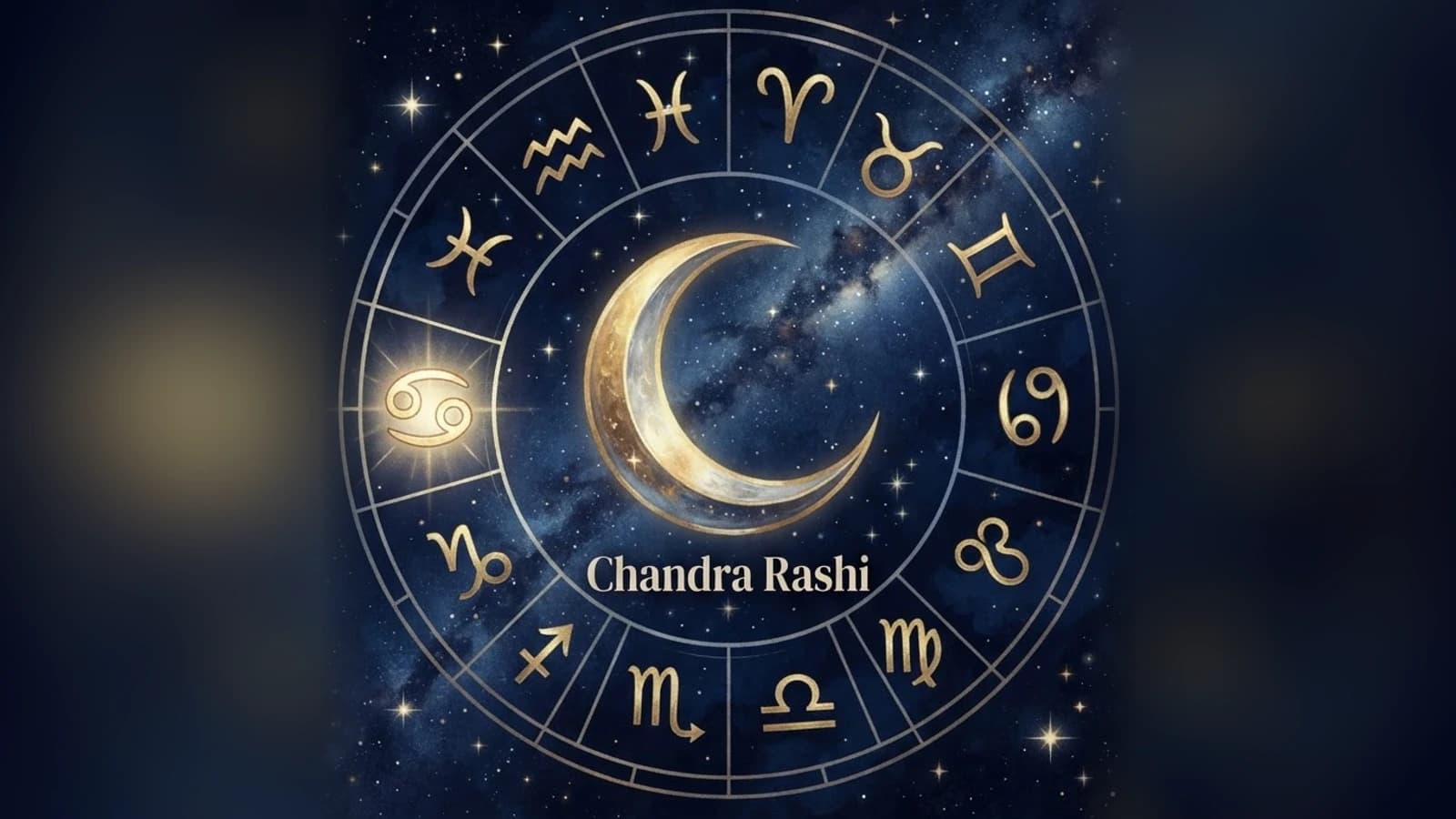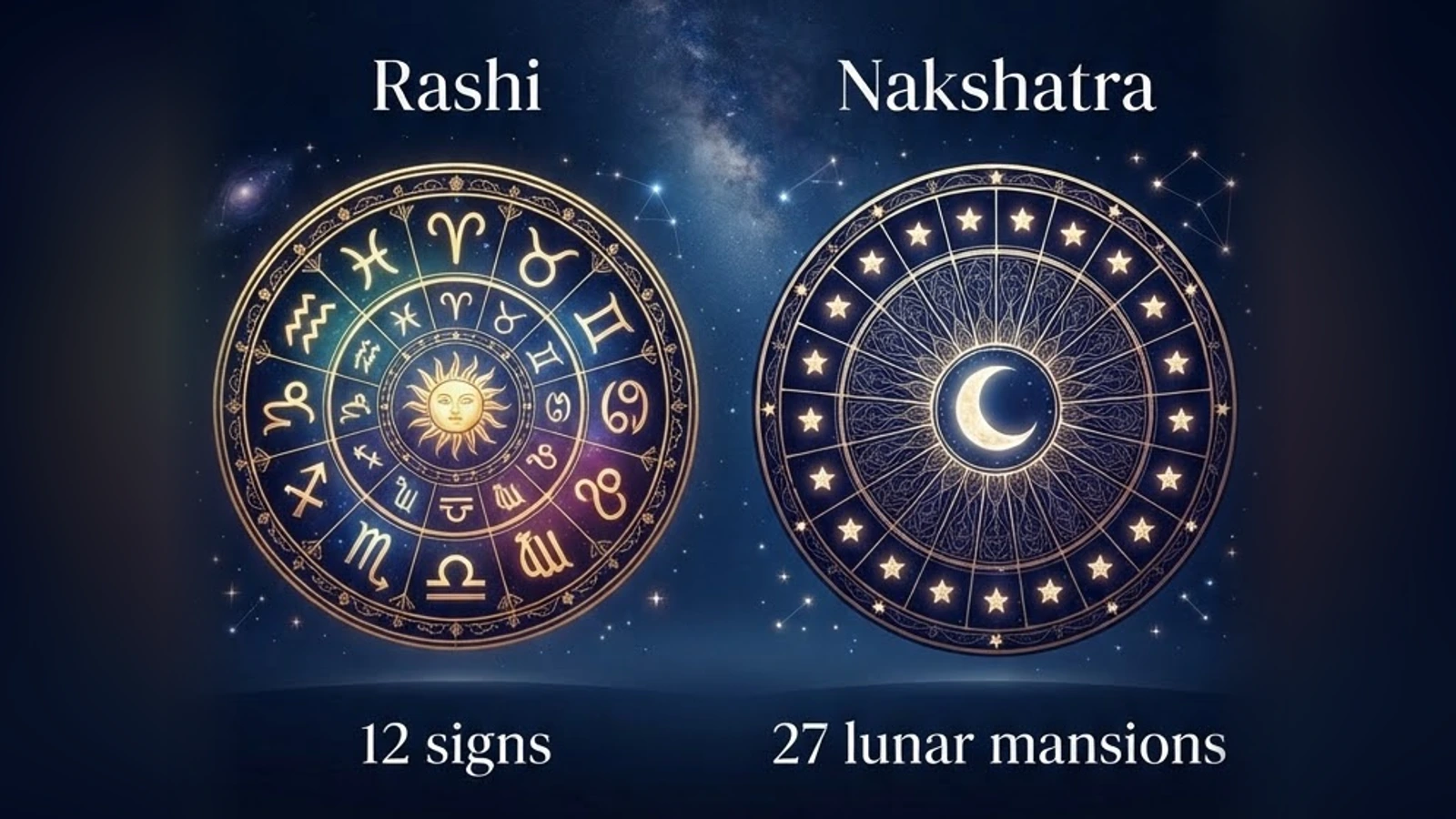
Ask someone in India for their Rashi and their Nakshatra, and you'll usually get two different answers: "Vrishabha Rashi, Rohini Nakshatra", for example. Both describe where the Moon was when they were born. The difference is resolution. The Rashi is the broad sign; the Nakshatra is a finer division inside it.
The two side by side
| Rashi | Nakshatra | |
|---|---|---|
| How many | 12 | 27 |
| Span | 30° each | 13°20′ each |
| Subdivisions | 9 Nakshatra padas per sign | 4 padas of 3°20′ each |
| Moon spends | About 2¼ days in each | About 1 day in each |
| Ruled by | Sign lords (Mars rules Aries, Venus rules Taurus…) | Vimshottari lords (Ketu, Venus, Sun, Moon, Mars, Rahu, Jupiter, Saturn, Mercury, repeating) |
| Origin | Shared with other zodiac traditions | Distinctly Indian lunar system |
| Main uses | Houses, planetary dignity, Rashifal | Dasha, naming syllable, Muhurta, several Guna Milan factors |
How they fit together
The zodiac is a 360° circle. Divide it by 12 and you get the Rashis. Divide the same circle by 27 and you get the Nakshatras. Because 27 doesn't divide evenly into 12, the two grids don't line up neatly.
The link between them is the pada, or quarter. Each Nakshatra has four padas of 3°20′, which makes 108 padas around the zodiac, and exactly nine padas fit into each sign. So a sign always contains two full Nakshatras and a quarter of a third, or a similar split across a boundary.
This is why nine Nakshatras straddle two signs: Krittika, Mrigashira, Punarvasu, Uttara Phalguni, Chitra, Vishakha, Uttara Ashadha, Dhanishta and Purva Bhadrapada. If your Moon is in one of these, the pada decides which sign it's in.
A worked example
Take two people, both with the Moon in sidereal Taurus.
- Person A: Moon at 15° Taurus. Rohini runs from 10° to 23°20′ Taurus, so the Moon is in Rohini, in its second pada (13°20′ to 16°40′).
- Person B: Moon at 25° Taurus. Mrigashira begins at 23°20′ Taurus, so the Moon is in Mrigashira, first pada.
Both would say "my Rashi is Vrishabha", and both would read the same Taurus Rashifal. But their Nakshatras differ, and that has a concrete effect: Rohini is ruled by the Moon and Mrigashira by Mars, so Person A's Vimshottari Dasha starts in a Moon period and Person B's in a Mars period. Their timelines diverge from birth.
What each is used for
Rashi
- The chart's structure. Houses are counted in whole signs from the Lagna in most Vedic practice, so sign placement decides which house a planet falls in.
- Planetary dignity. Exaltation, debilitation and own-sign status are defined by sign; see exalted and debilitated planets.
- Rashifal. Daily and monthly horoscopes in India are usually written by Moon sign.
- Transits. Sade Sati, for example, is defined by Saturn's movement through the signs around your Moon sign.
Nakshatra
- Dasha. The Moon's Nakshatra at birth sets the first Mahadasha and how much of it remains.
- Naming. Each pada has a traditional starting syllable. A child born with the Moon in Rohini's four padas would traditionally be given a name beginning with O, Va, Vi or Vu respectively.
- Muhurta. Auspicious timing often depends on the day's Nakshatra; see what is Panchang.
- Temperament. Many astrologers read the Nakshatra as a more specific layer of personality than the sign alone. Our list of the 27 Nakshatras gives each one's ruler and deity.
Both, in Kundli matching
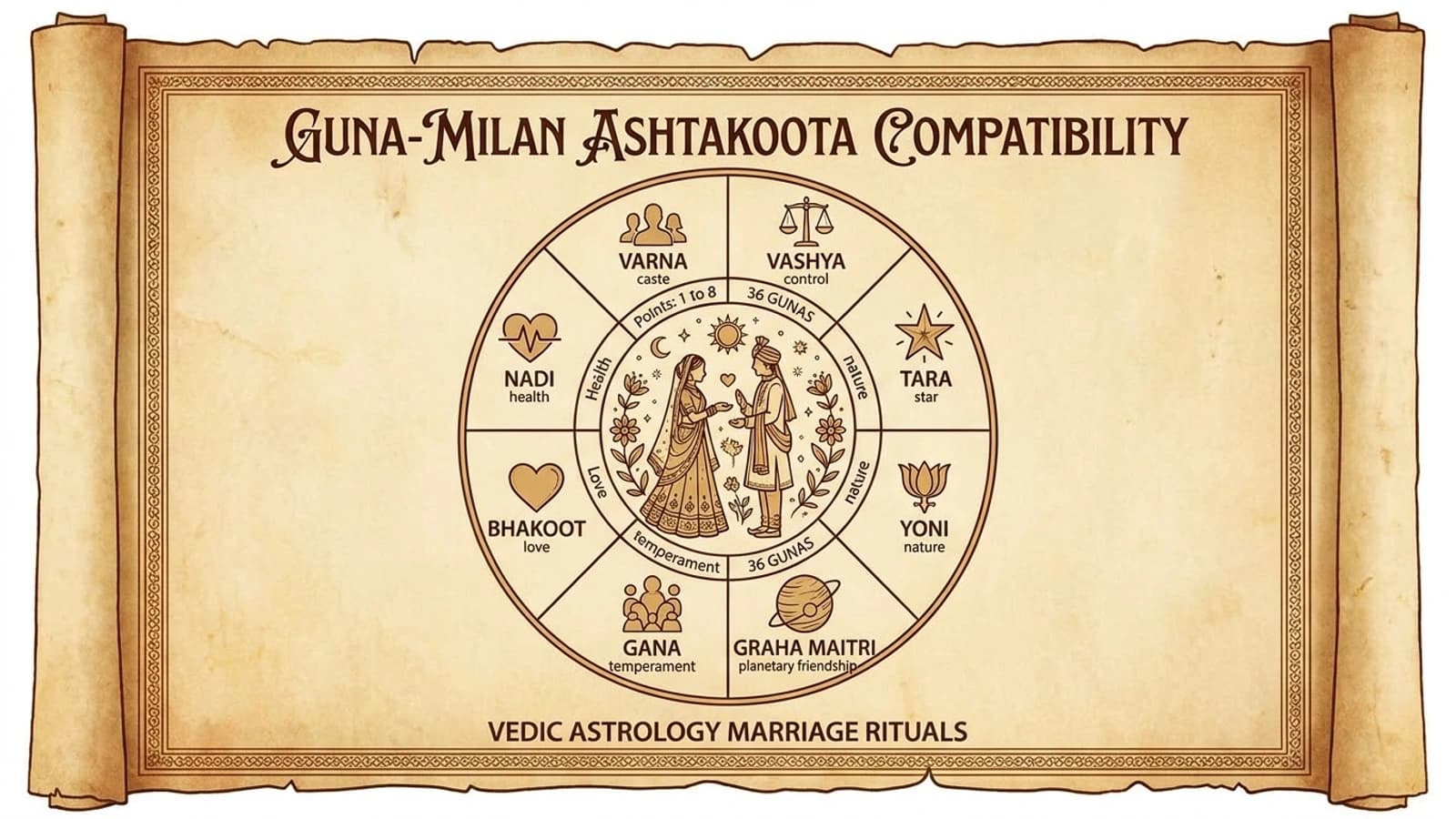
Guna Milan, the traditional 36-point compatibility check, uses both. Of its eight factors, four are read from the Nakshatras (Tara, Yoni, Gana and Nadi) and four from the signs or their lords (Varna, Vashya, Graha Maitri and Bhakoot). It's a good illustration that the two aren't competing systems but two levels of the same map.
Common mix-ups
- Confusing Rashi with Sun sign. A Western "Leo" is a tropical Sun sign; a Vedic Rashi is usually the sidereal Moon sign. They often differ entirely. See Rashi vs Sun sign.
- Assuming a Nakshatra belongs to one sign. Nine of them cross a sign boundary, so check the pada.
- Ignoring birth time. The Moon moves about 13° a day: roughly one Nakshatra a day and one pada every six hours. Near a boundary, even a short error matters. If you're unsure of your time, see how to find an unknown birth time.
Finding yours
You need your birth date, time and place. Aroha's Moon sign calculator gives your Rashi and Nakshatra together, and the free Kundli shows them alongside the rest of your chart.