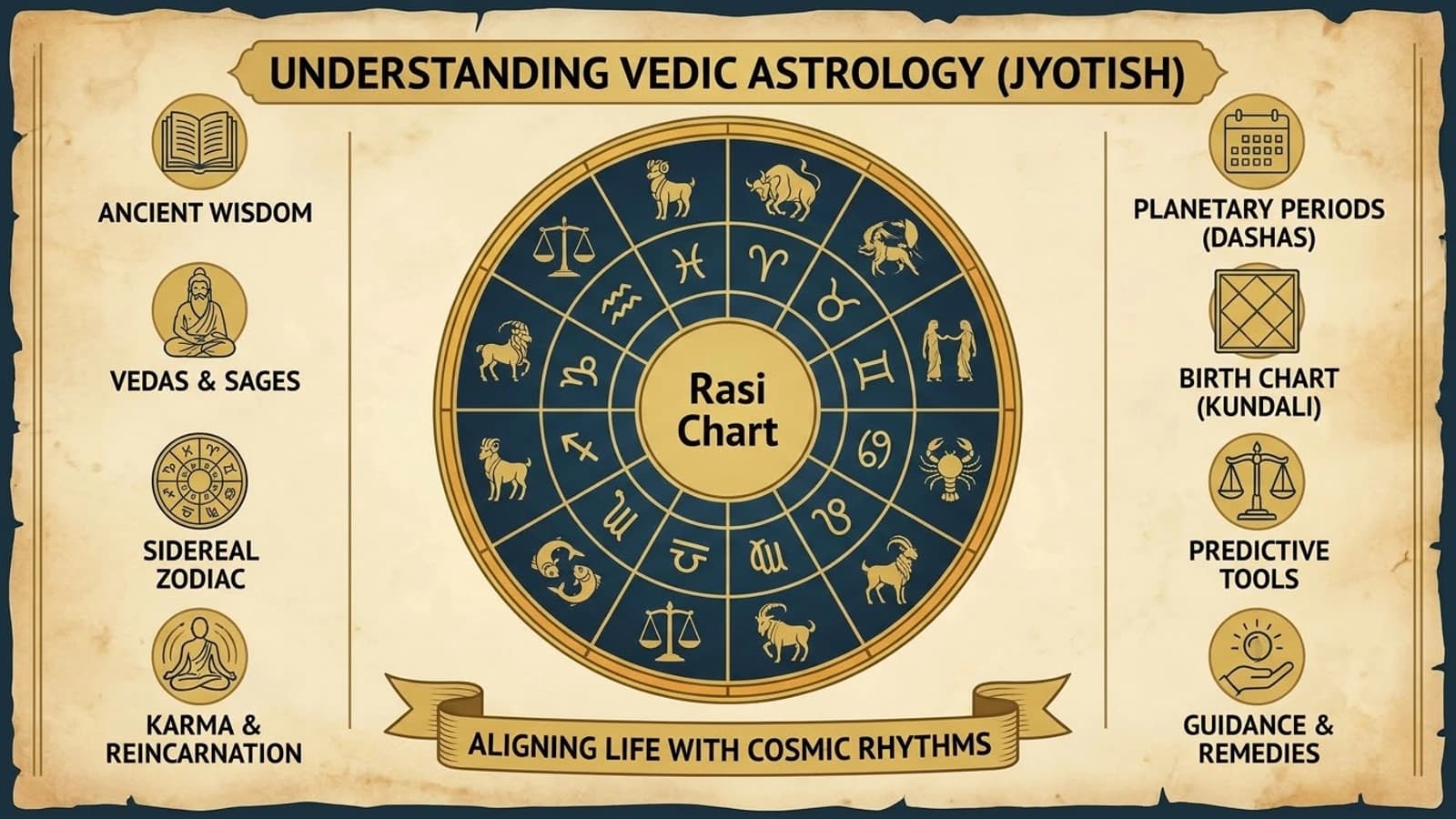
A Kundli is a stack of charts. The main birth chart, called the Rashi chart or D1, shows where each planet sits by whole sign. But classical Jyotish doesn't stop there: it re-divides each sign into smaller segments, called Vargas or divisional charts, and re-plots every planet across each one to check how strong it really is.
Why divide a chart at all
Two planets can sit in the same sign in the D1 chart and still not be equally strong. Splitting each 30° sign into smaller portions (a ninth, a tenth, a twelfth, and so on) and checking which finer segment a planet falls into gives a second, independent read on that planet's real condition, the way a coarse filter and a fine filter catch different things.
Navamsa (D9): the second-most important chart
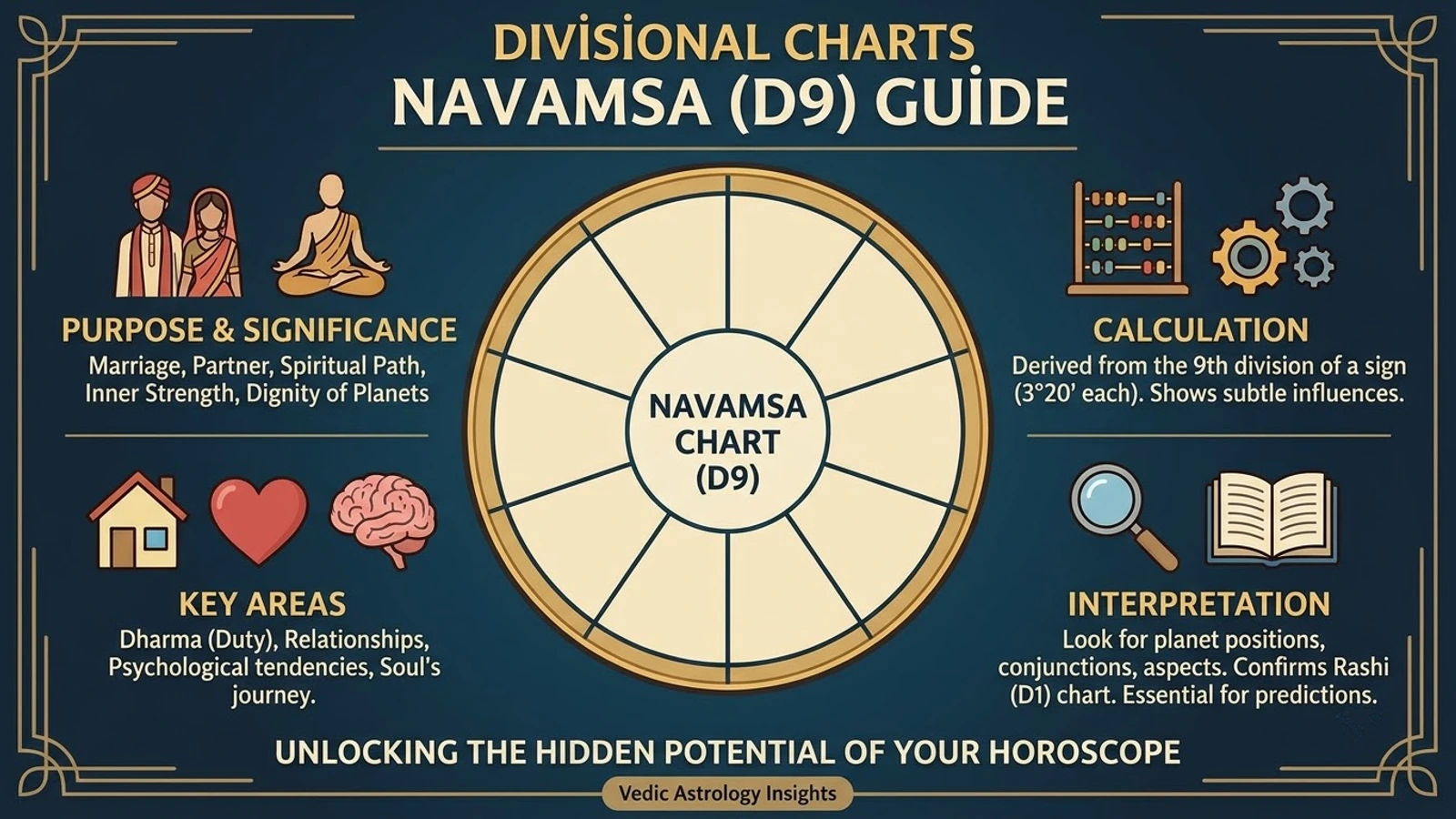
Of the divisional charts, the Navamsa (D9) is treated as second in importance only to the D1 itself. Each sign is split into nine equal Navamsa portions of 3°20' each. D9 is read specifically for marriage, spouse, and dharma, but its real weight in practice is broader: a planet that looks strong in the D1 but lands poorly in the D9 is traditionally considered less reliably strong than one that holds up in both.
Vargottama: strong in both charts at once
When a planet falls in the same sign in both the D1 and the D9, it's called Vargottama, considered a marker of unusual strength and stability for that planet's significations, because the placement holds up under the finer-grained check rather than only looking good at a glance.
The rest of the set
Beyond D1 and D9, classical texts define a wider set of Vargas, traditionally organized as the Shodashvarga (sixteen-chart system), each tied to a specific life theme:
- D7 (Saptamsa): children
- D10 (Dasamsa): career and public standing
- D12 (Dwadasamsa): parents
- D24 (Chaturvimsamsa): education and learning
- D60 (Shashtiamsa): the finest division of all, considered by many classical authorities the ultimate word on a planet's true underlying strength
Checking the Navamsa is one step in a full chart reading. See how to read your Vedic birth chart for the complete sequence.
See your own divisional charts
Aroha computes your full set of divisional charts, D1 through D60, from your exact birth details. Explore your Navamsa and the rest of your Vargas in the .