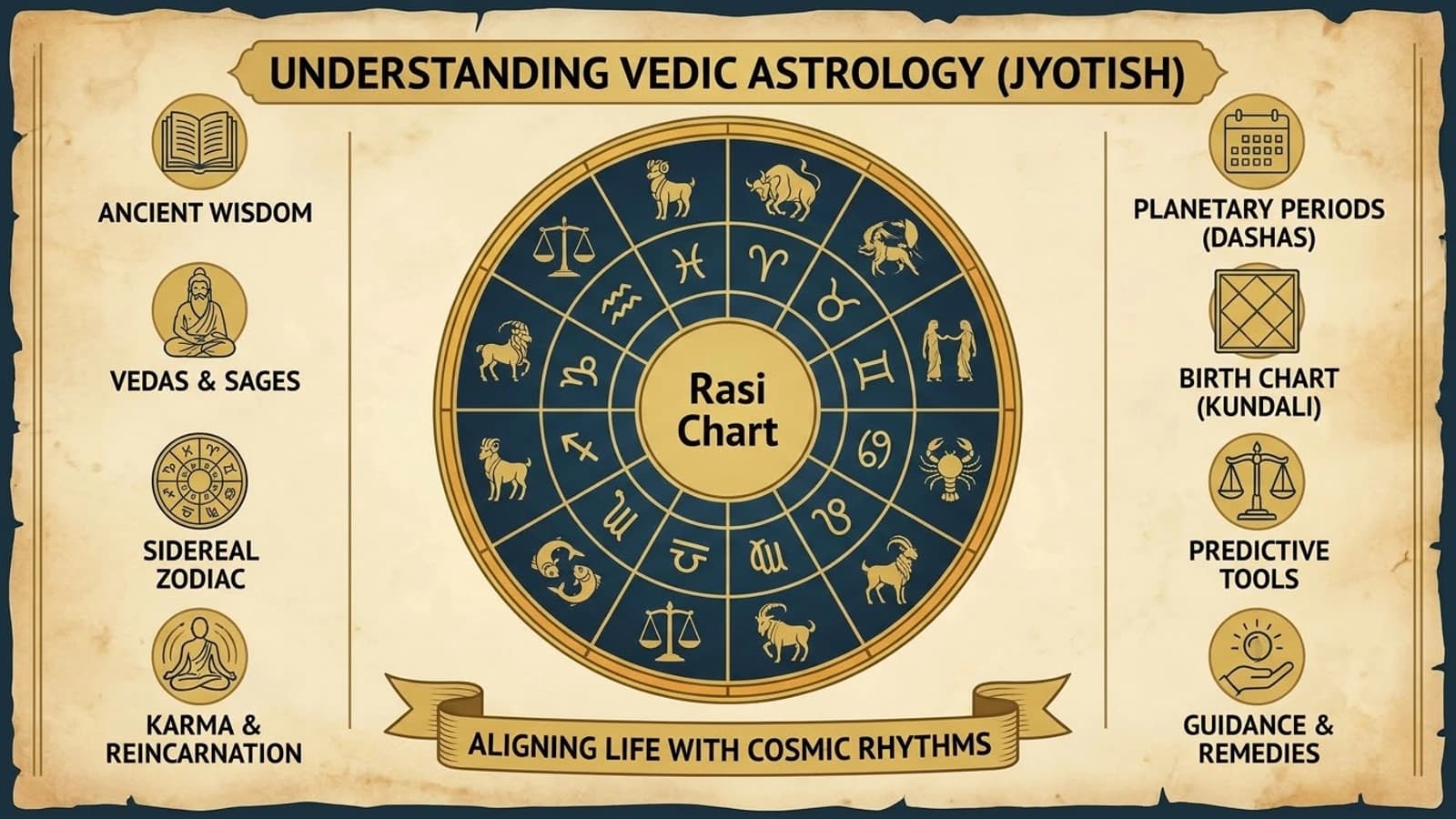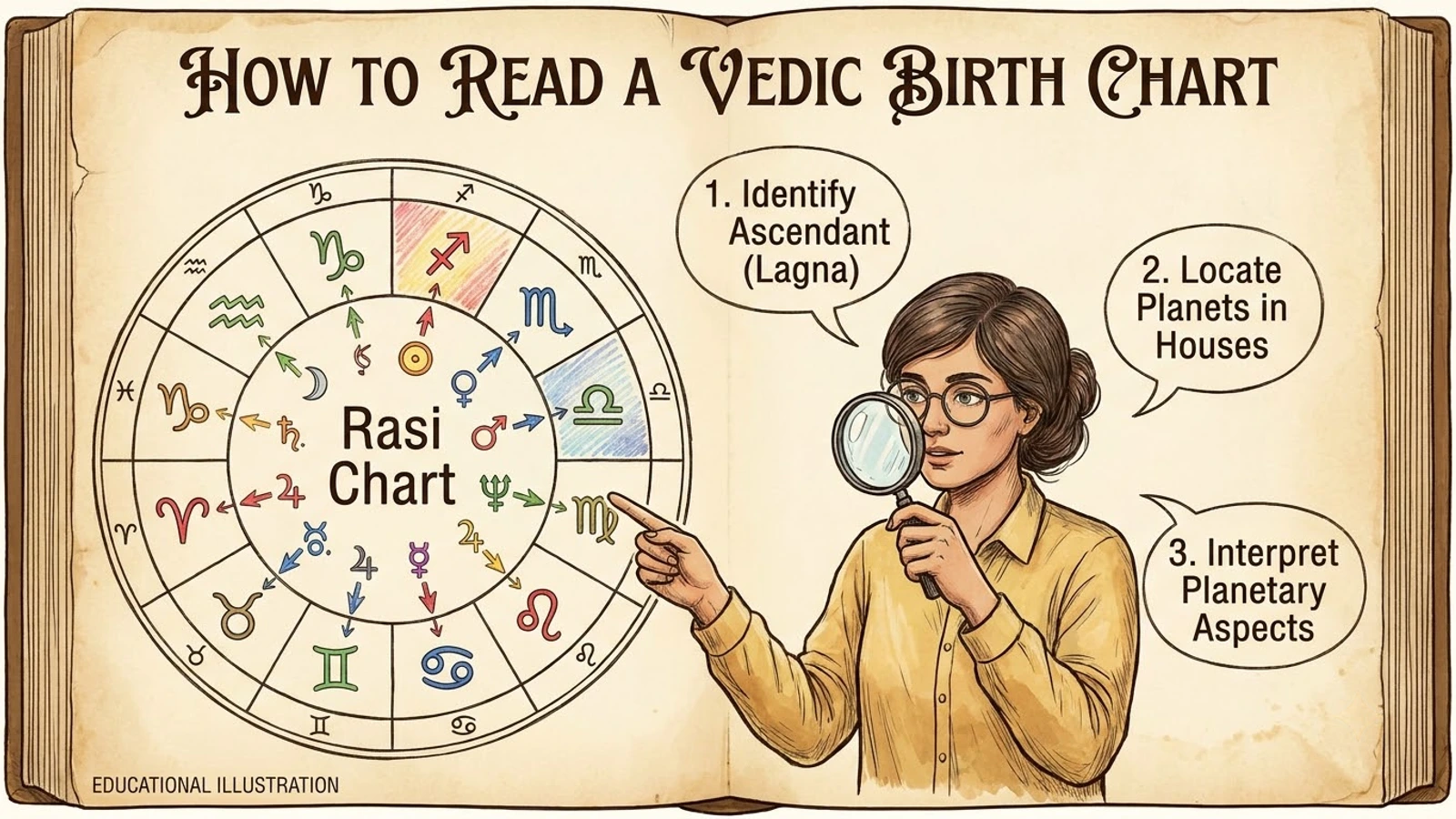
A Vedic birth chart holds a lot of information at once, which is exactly why it can feel overwhelming the first time you look at one. The way to read it is to work through it in a consistent order. Here's that order, step by step.
Step 1: Check your birth details
Every downstream calculation depends on three inputs: your date, your exact time, and your location of birth. Accuracy matters most for time: even a small error can shift your Ascendant and, with it, every house in your chart.
Step 2: Identify the Lagna
Your Ascendant is the anchor point for the entire chart: the sign rising on the horizon at your birth moment. See What Is Lagna? for the full explanation.
Step 3: Understand the 12 houses
Once you know your Lagna, you know which house is which. Read through 12 Houses in Vedic Astrology to see what each one governs.
Step 4: Locate the planets
Find where each of the nine Grahas (Sun, Moon, Mars, Mercury, Jupiter, Venus, Saturn, Rahu and Ketu) sits by sign and house. This is the raw data your chart is built from.
Step 5: Assess planetary strength
For each planet, look at:
- Exaltation or debilitation
- Whether it's in its own sign
- Combustion
- Retrograde status
- Conjunctions with other planets
- Aspects it's receiving
This step tells you how strongly each planet is likely to express its themes.
Step 6: Examine important yogas
Check for the major planetary combinations (Raj Yoga, Dhan Yoga, Manglik Dosha and others) that shape how the chart's individual pieces interact as a whole.
Step 7: Check the Navamsa
The D9 chart adds a finer layer of detail, especially for marriage and inner strength. See Divisional Charts: Navamsa (D9) and the Vargas Explained.
Step 8: Check your Vimshottari Dasha
Dashas tell you when different planetary themes are active across your life. See the full guide: How to Read Your Vimshottari Dasha.
Step 9: Check current transits
Overlay today's planetary positions onto your natal chart to see what's currently being activated. See Planetary Transits Explained: What Is Gochar?
Step 10: Interpret the chart as a whole
This is the step that's easiest to skip and most important not to: a single placement should never be used to make an absolute prediction on its own. A complete interpretation weighs the interaction between your Lagna, houses, house lords, planets, planetary strength, aspects, yogas, Dashas, transits and divisional charts together, not one at a time.
Want to understand your own birth chart?
Generate your free Kundli with Aroha Astrology and explore your Lagna, Rashi, Nakshatra, planetary placements, Dashas and more: all calculated from your exact birth details.