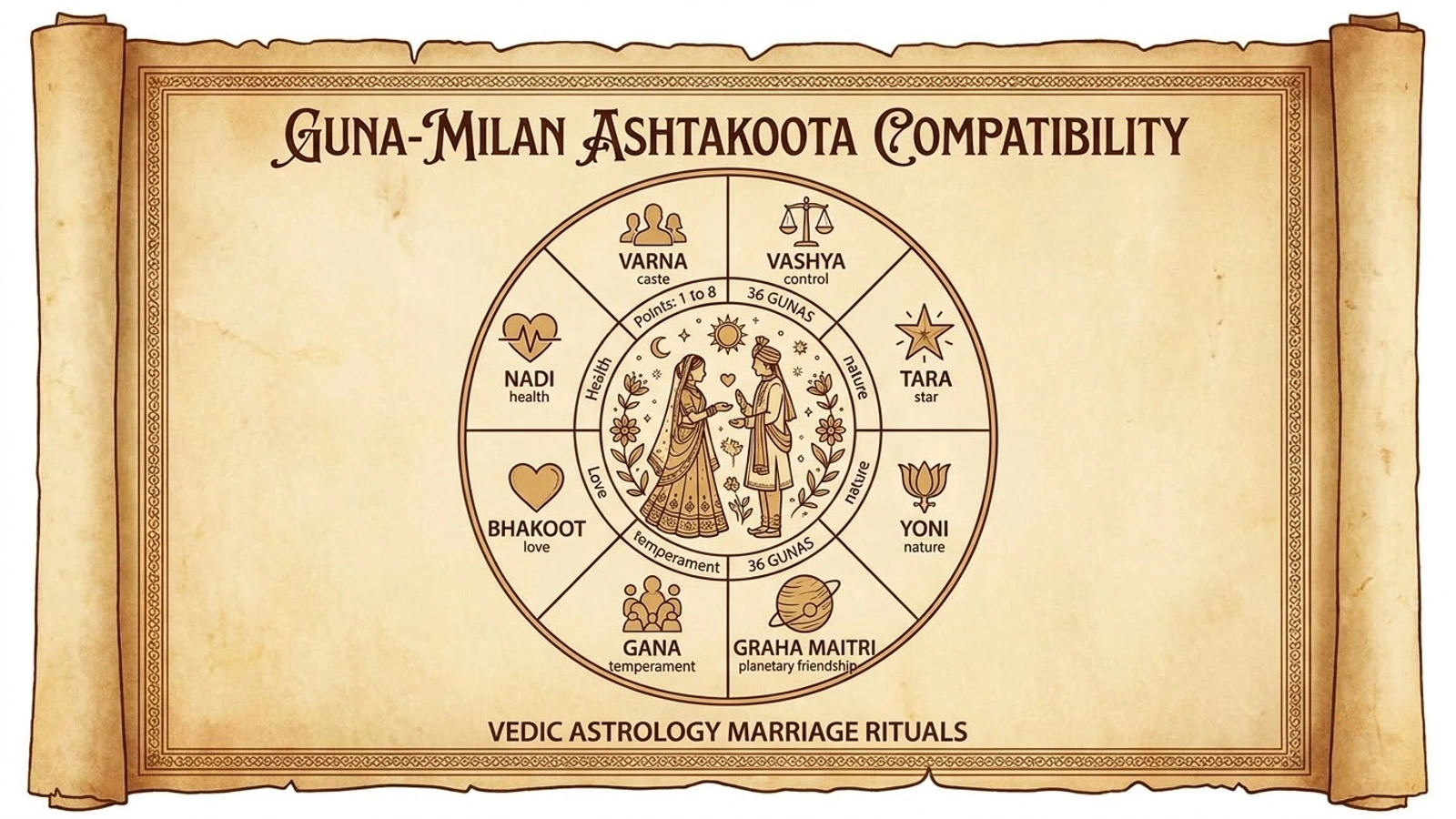
Before a Vedic wedding is arranged, it's common practice to compare the couple's birth charts using a system called Guna Milan, literally "matching of qualities." The version most widely used today, Ashtakoota ("eight kootas"), scores compatibility across eight specific factors, out of a maximum of 36 points.
The eight kootas, and what each one checks
- Varna (1 point): spiritual and temperament compatibility, based on each person's Moon sign group.
- Vashya (2 points): mutual influence between the two, based on sign groupings.
- Tara (3 points): general wellbeing, counted from each person's birth Nakshatra to the other's.
- Yoni (4 points): physical compatibility, matched by the animal symbol assigned to each Nakshatra.
- Graha Maitri (5 points): friendship between the planetary lords of each person's Moon sign.
- Gana (6 points): temperament group (Deva, Manushya, or Rakshasa) of each Nakshatra.
- Bhakoot (7 points): compatibility based on the distance between the two Moon signs, linked to prosperity and family wellbeing.
- Nadi (8 points): health and progeny, based on each Nakshatra's Nadi (Vata, Pitta, Kapha) classification.
Notice the points aren't evenly weighted: Nadi alone accounts for over a fifth of the total 36, which is why it's treated as one of the two "critical" kootas.
Why the total score isn't the whole story
A widely used rule of thumb treats 18 out of 36 as a workable minimum, with scores in the mid-20s and above considered strong, but that single number can be misleading. Nadi Dosha (both partners sharing the same Nadi, scoring zero on that koota) and Bhakoot Dosha (an unfavorable sign-distance between the two Moons) are traditionally weighted heavily enough that many astrologers check them independently of the overall total, even when the combined score looks fine.
Cancellation (Bhanga) rules
As with other doshas in Jyotish, both Nadi Dosha and Bhakoot Dosha have traditional cancellation conditions: specific chart combinations under which the dosha is considered non-functional. Exactly which conditions count as cancellation varies between regional traditions, which is why the same two charts can occasionally get different verdicts from different astrologers.
More than a scorecard
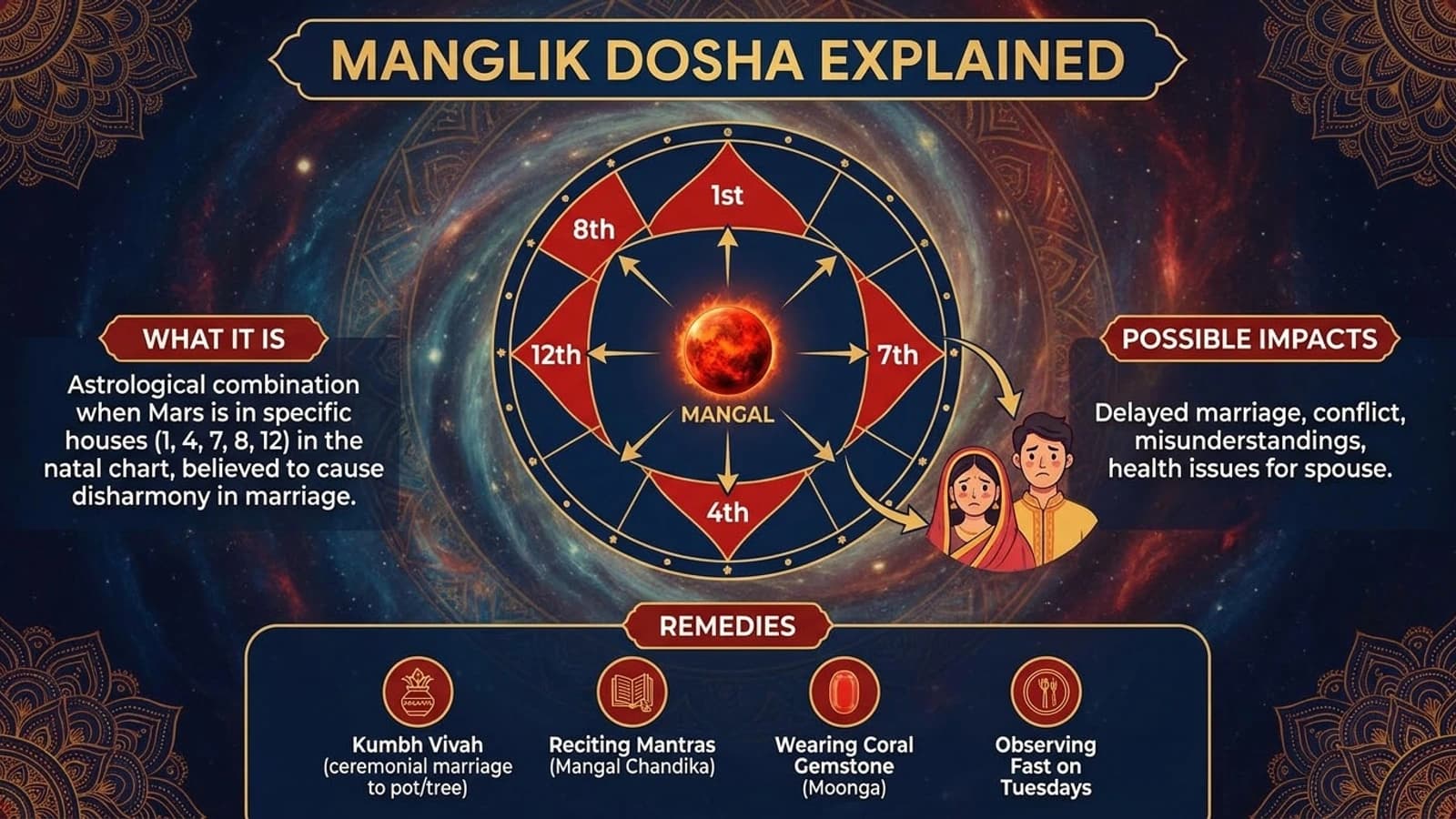
Ashtakoota is the most standardized layer of Vedic matching, but a fuller compatibility reading also looks at Manglik status (see what is Manglik Dosha) and the broader strength of each chart. Guna Milan is a structured starting point, not a replacement for reading both charts properly.
Check your own compatibility
See a full Ashtakoota Guna Milan score, along with Manglik and dosha checks, by comparing two charts in the .