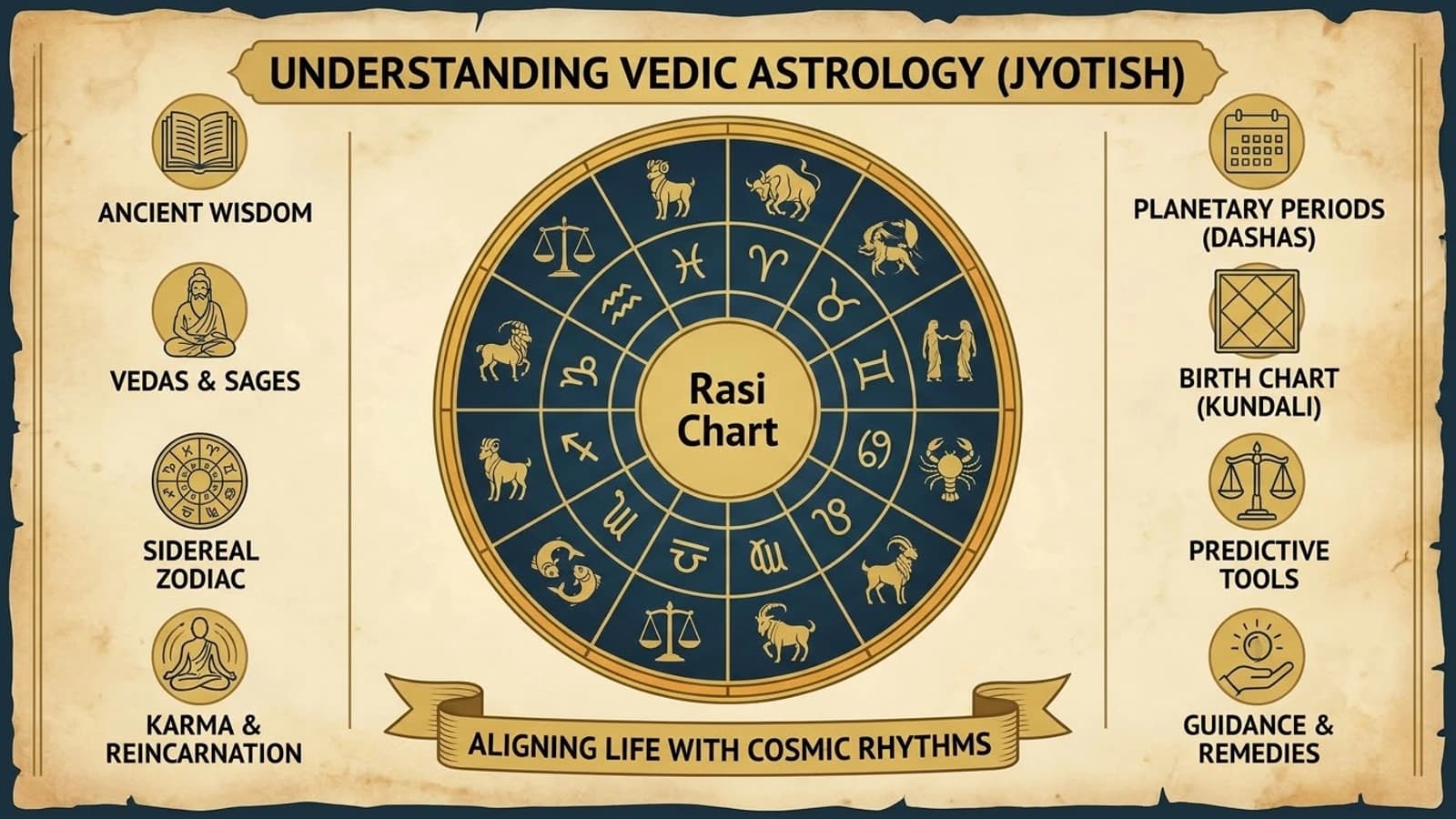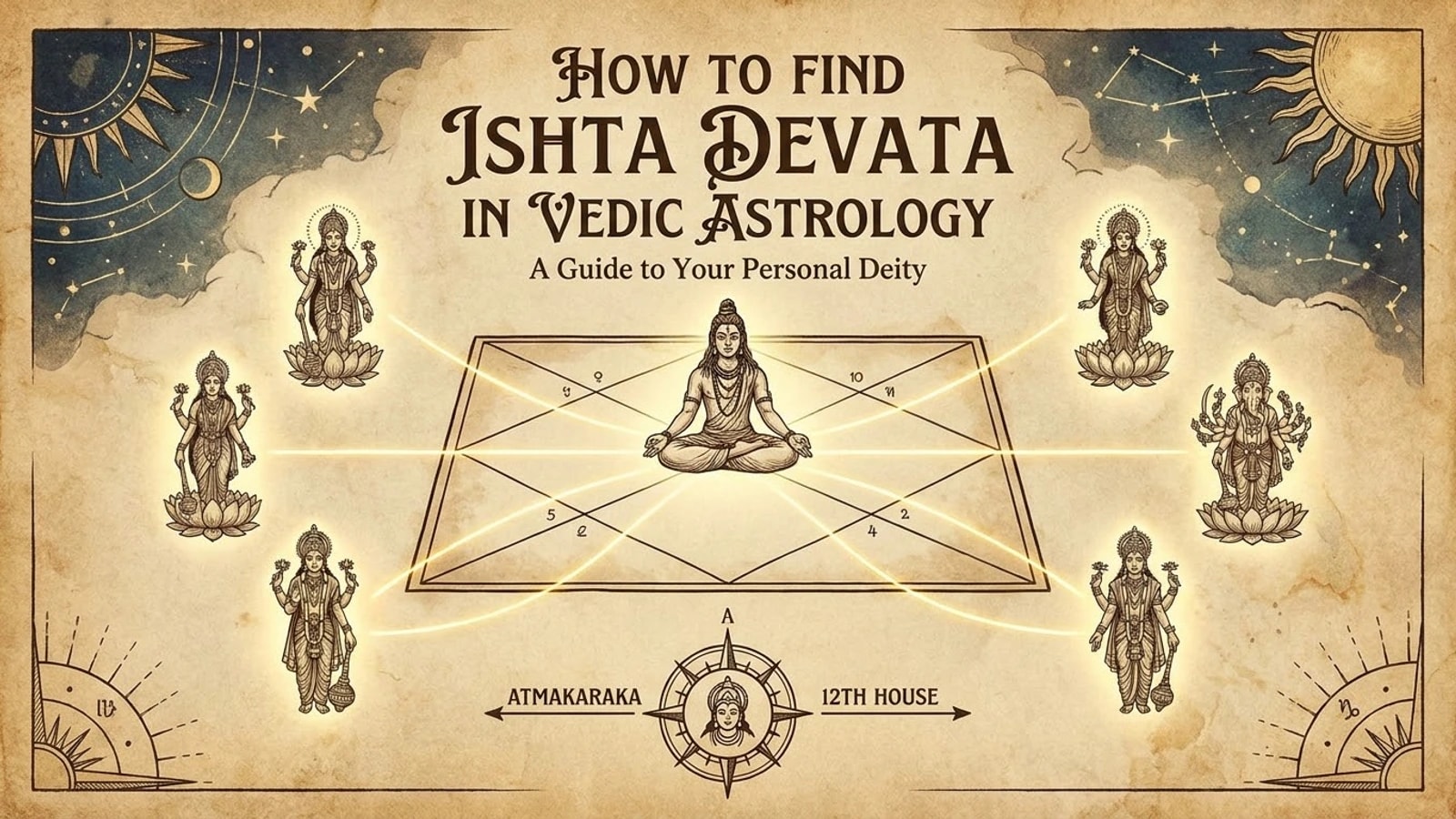
Of all the questions a Kundli can be asked to answer, "who is my Ishta Devata" is one of the more advanced ones, it sits in Jaimini astrology rather than the Parashari system most beginner guides cover, and it's a topic where different traditions genuinely disagree on method. This guide walks through the most commonly taught approach, and is direct about where the disagreement lies.
What Is an Ishta Devata?
Ishta Devata means "chosen" or "beloved deity", a personal deity traditionally considered especially significant for an individual, often indicated by their own birth chart rather than inherited or assigned by tradition alone.
Ishta Devata vs. Kuladevata vs. Family Deity
It's worth separating three related but distinct ideas. A Kuladevata is a family or lineage deity, generally shared across a family and passed down rather than individually calculated. A broader "family deity" can simply mean whichever deity a household traditionally worships, for reasons of region or custom rather than astrology. Ishta Devata, by contrast, is personal, traditionally derived from the individual's own chart, distinct from what their family already worships.
Can Your Kundli Indicate an Ishta Devata?
Traditionally, yes, through Jaimini-specific techniques, though this isn't the only lens tradition offers. Family lineage, a guru's guidance, or a personal sense of resonance with a particular deity are all traditionally valid ways people arrive at an Ishta Devata, independent of chart calculation. The method below is one traditional approach among several.
The Traditional Jaimini Method
The most commonly taught chart-based method runs through the Atmakaraka and Karakamsha.
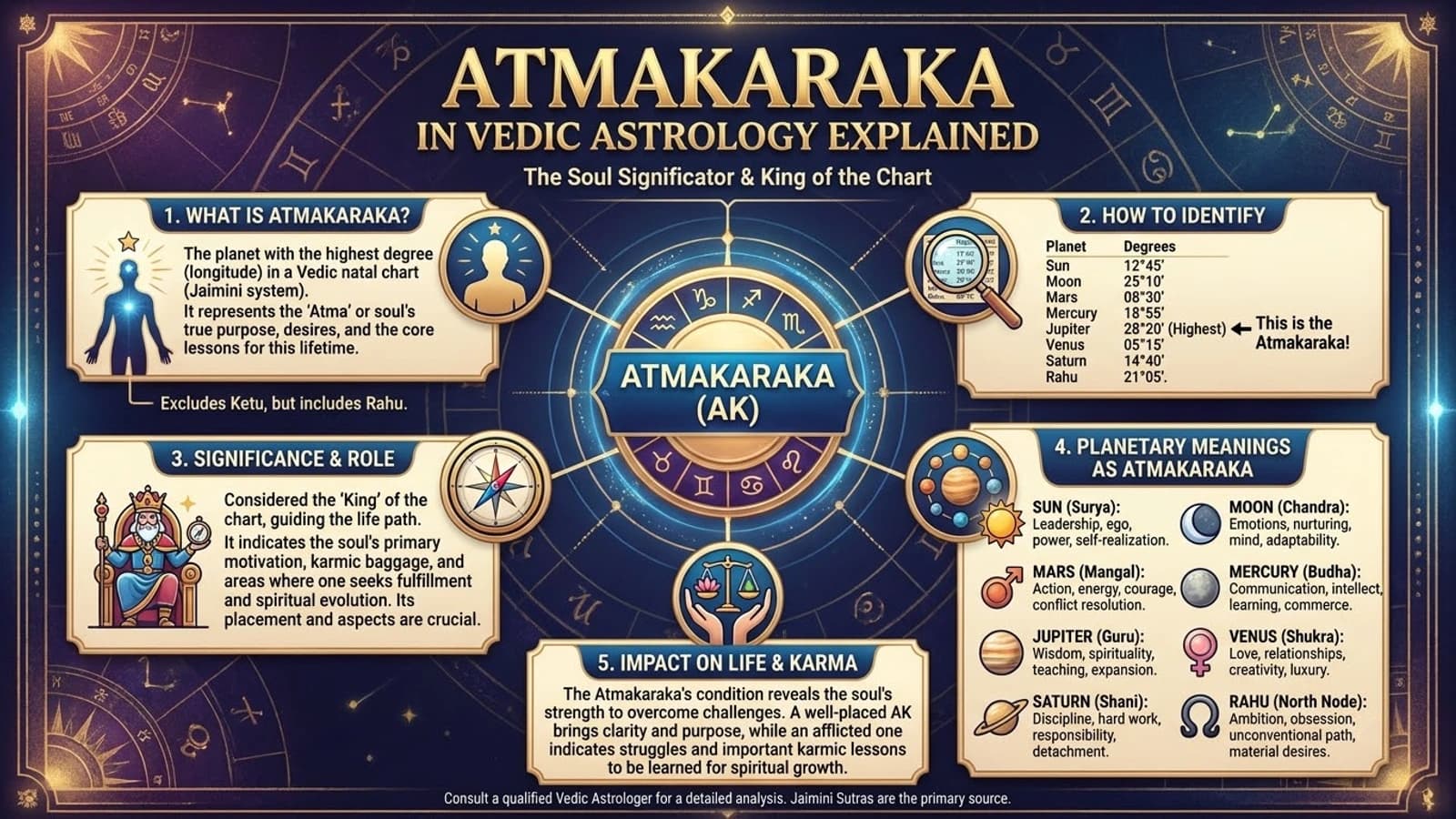
Step 1: Find the Atmakaraka
The Atmakaraka is the planet at the highest degree in your birth chart. See what is Atmakaraka for the full method, including the genuine disagreement over whether Rahu is included in the comparison.
Step 2: Find the Karakamsha
The Karakamsha is the sign the Atmakaraka occupies in the Navamsa (D9) chart, treated in Jaimini astrology as a second, soul-level ascendant point, distinct from the main chart's Lagna.
Step 3: Locate the 12th House From Karakamsha
From the Karakamsha sign, count twelve houses forward: this position, the 12th from Karakamsha, is the traditional focus point for identifying the Ishta Devata.
Step 4: Interpret the Planet Associated With That Position
The planet ruling, or placed in, that 12th-from-Karakamsha position is traditionally read against a set of classical planet-to-deity correspondences to arrive at the indicated Ishta Devata.
Planetary Associations and Traditional Deity Correspondences
Classical texts associate each graha with particular deities: Sun with Shiva or Surya, Moon with Krishna or Devi in her nurturing forms, Mars with Subrahmanya or Hanuman, Mercury with Vishnu, Jupiter with Vishnu or Dakshinamurthy, Venus with Lakshmi or Devi, and Saturn with Shiva in his ascetic form, among other associations. These correspondences themselves vary between texts and lineages. Treat the pairing as a traditional starting point for reflection, not a rigid one-to-one lookup table.
Important Limitations and Different Traditions
Be direct with yourself about this: there is no single, universally agreed method for determining Ishta Devata across all of Vedic astrology. Different astrologers apply different rules for the calculation itself, different lineages use different planet-to-deity correspondence tables, and some traditions bypass chart calculation for this question entirely. Two careful astrologers working from the same birth data can reasonably arrive at different answers.
Can You Worship More Than One Deity?
Yes, traditionally. An Ishta Devata is generally described as a particularly resonant or primary focus for an individual, not an exclusive one that requires setting other worship aside.
Frequently Asked Questions
Is there one fixed method to find Ishta Devata?
No. The Atmakaraka/Karakamsha method described here is a widely taught traditional approach, but different astrologers and lineages apply different rules, and some traditions determine an Ishta Devata through entirely different means, such as family or guru guidance rather than chart calculation alone.
Is Ishta Devata the same as Kuladevata?
No. Kuladevata is a family or lineage deity, generally inherited and shared across a family rather than calculated from an individual's own chart. Ishta Devata is personal to the individual, traditionally derived from their own birth chart.
Can I worship more than one deity?
Traditionally, yes: an Ishta Devata is described as a primary or especially resonant focus, not an exclusive one. Most traditions don't treat identifying an Ishta Devata as a reason to set aside other worship.
See your Atmakaraka and Karakamsha
Generate your free Kundli with Aroha Astrology to see your Atmakaraka and Navamsa chart calculated, as the starting point for exploring this yourself or with a traditional astrologer.