Most of what's covered in a typical Kundli reading (houses, signs, dignity, Dasha) comes from the Parashari system. The Atmakaraka comes from a different branch entirely: Jaimini astrology, which reads the chart through significators rather than fixed house rulerships, and treats this one planet as the key to the chart's deeper themes.
What Is Atmakaraka?
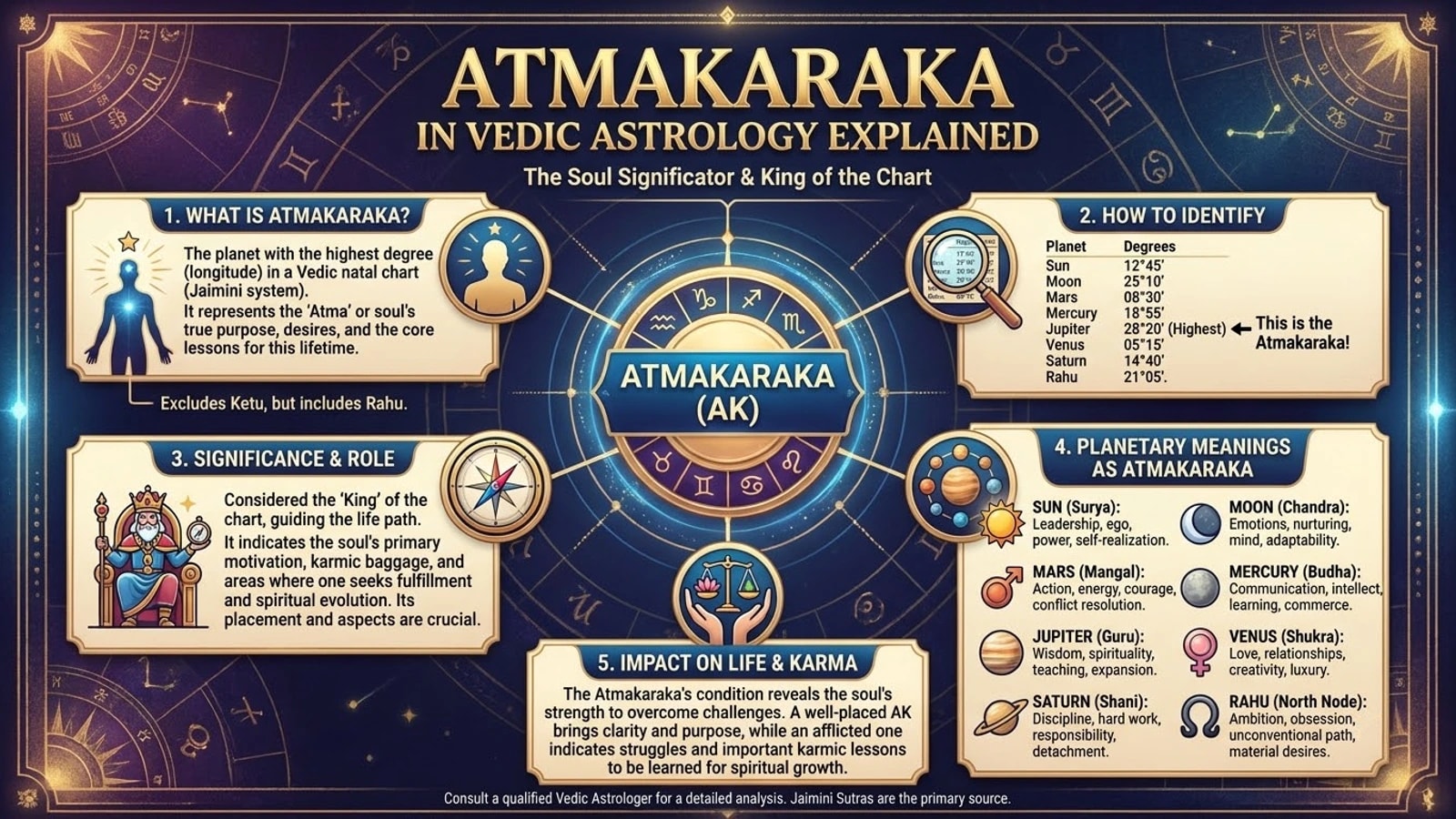
Atmakaraka literally means "significator of the soul": in Jaimini astrology, it's the planet believed to carry the native's core life themes and deepest motivations, distinct from what any single house or sign placement shows on its own.
The Meaning of Atmakaraka in Jaimini Astrology
Where Parashari astrology reads a fixed house (like the 1st house) for self and identity, Jaimini astrology instead identifies significator planets by degree, planets that earn their role through their specific position in this one chart, rather than through a fixed rule that applies the same way to everyone. The Atmakaraka is the most important of these Jaimini significators, and forms the starting point for several Jaimini-specific techniques, including the Karakamsha chart used to find an Ishta Devata.
How to Find Your Atmakaraka
Look at the degree each of the seven classical planets (Sun, Moon, Mars, Mercury, Jupiter, Venus, Saturn) occupies within its own sign. Every planet sits somewhere between 0° and 30° in whatever sign it's in. Whichever planet holds the highest degree among them is the Atmakaraka.
Does Rahu Count? Why Different Methods Give Different Results
This is a genuine methodological split, not a settled question. Some Jaimini practitioners include Rahu in the degree comparison (Ketu is conventionally excluded even in these methods); others restrict the comparison to the seven classical planets only. Because Rahu often sits at a high degree in many charts, including or excluding it can change which planet comes out as Atmakaraka, which is also why two different tools or astrologers can occasionally disagree on the result for the same birth data.
Meaning of Each Planet as Atmakaraka
Sun Atmakaraka
Traditionally linked to themes of authority, identity, ego and self-direction as the chart's central life lesson.
Moon Atmakaraka
Traditionally linked to emotional depth, the mind, and themes of nurturing or being nurtured as central to the native's path.
Mars Atmakaraka
Traditionally linked to courage, drive and assertiveness, a life theme built around action and independence.
Mercury Atmakaraka
Traditionally linked to intellect, communication and adaptability as the core thread running through the native's growth.
Jupiter Atmakaraka
Traditionally linked to wisdom, teaching and higher belief systems, often read as a life oriented toward knowledge or guidance of others.
Venus Atmakaraka
Traditionally linked to relationships, harmony, and aesthetic or creative sensibility as central life themes.
Saturn Atmakaraka
Traditionally linked to discipline, endurance and lessons learned through effort and restriction over time.
Rahu Atmakaraka
Where included, traditionally linked to unconventional ambition and themes the native pursues outside inherited patterns, read cautiously given the disagreement over whether Rahu should be counted at all.
Atmakaraka and Karakamsha
The Karakamsha is a specific point derived from the Atmakaraka: the sign the Atmakaraka occupies in the Navamsa (D9) chart, treated as a second, Jaimini-specific ascendant for reading deeper soul-level themes. See divisional charts and the Navamsa for how the D9 itself is calculated.
Atmakaraka and Ishta Devata
One of the main traditional uses of the Atmakaraka and Karakamsha together is identifying an Ishta Devata, a personal deity indicated by the chart. That method builds directly on the Atmakaraka established here; see how to find your Ishta Devata for the full step-by-step process.
Frequently Asked Questions
How do I find my Atmakaraka?
Find the degree each planet occupies within its own sign (0-30°), across the seven classical planets (Sun through Saturn). Whichever planet holds the highest degree is your Atmakaraka. Some methods include Rahu in the comparison; others don't. This is one of the points where approaches genuinely differ.
Can the Moon or Saturn be an Atmakaraka?
Yes, any of the seven classical planets can end up as the Atmakaraka; it depends entirely on degree position in your specific chart, not on which planet is traditionally considered strong or weak.
Is Atmakaraka the same in every astrology software?
Not always. Differences in whether Rahu is included, and occasionally in rounding at very close degrees, mean two tools can occasionally disagree on the result for the same birth data. It's worth checking which method a given source uses when comparing results.
Find your Atmakaraka
Generate your free Kundli with Aroha Astrology to see each planet's exact degree and your calculated Atmakaraka, as part of your full chart breakdown.