Listen to any puja and you'll hear several kinds of recitation: a few syllables repeated on a mala, a verse chanted in Sanskrit, a long hymn of praise, a song sung while a lamp is waved. People often call all of them "mantras", but the tradition distinguishes between them, and knowing the difference makes a puja easier to follow.
At a glance
| Form | What it is | Typical language | Well-known example |
|---|---|---|---|
| Mantra | A sacred formula for worship or meditation, often repeated | Sanskrit, often Vedic | Gayatri mantra; "Om Namah Shivaya" |
| Shloka | A verse, often in the two-line anushtubh metre | Sanskrit | A verse of the Bhagavad Gita |
| Stotra | A hymn of praise of many verses | Sanskrit | Vishnu Sahasranama |
| Aarti | Waving a lamp, and the song sung with it | Hindi and regional languages | "Om Jai Jagdish Hare" |
| Bhajan / kirtan | A devotional song, often sung together | Regional languages | Countless, across every region |
| Chalisa | A hymn of forty verses | Awadhi, Hindi | Hanuman Chalisa |
Mantra
A mantra is a word, syllable or formula recited for its sound and meaning. The oldest come from the Vedas and are traditionally chanted with precise pronunciation and pitch. The Gayatri mantra, from the Rigveda, is among the best known; so is the single syllable Om. Others are short devotional formulas addressed to a deity, such as "Om Namah Shivaya" or "Om Namo Narayanaya".
Mantras are often repeated a set number of times, a practice called japa, counted on a mala of 108 beads. The number 108 recurs across Hindu tradition; astrologers note, for instance, that there are 108 Nakshatra padas. Some mantras, particularly Vedic ones, are traditionally learned from a teacher. Your family or priest can guide you on which are appropriate for daily recitation.
Shloka
Shloka simply means verse. Most commonly it refers to a Sanskrit couplet in the anushtubh metre, the metre of most of the Bhagavad Gita, the Mahabharata and the Ramayana. A shloka can be about anything: philosophy, story, instruction.
In daily worship, people often recite short devotional shlokas, like the verse to Ganesha that begins Vakratunda Mahakaya before starting any task, or verses of the Gita. When a shloka is recited as a prayer, it functions much like a mantra, which is why the words overlap in everyday speech.
Stotra
A stotra is a hymn of praise: a longer composition of many verses addressed to a deity, often listing their names and qualities. The Vishnu Sahasranama (the thousand names of Vishnu), the Lalita Sahasranama and many hymns attributed to Adi Shankaracharya are well-known stotras. Reciting a stotra is a common part of weekly or festival worship.
Aarti
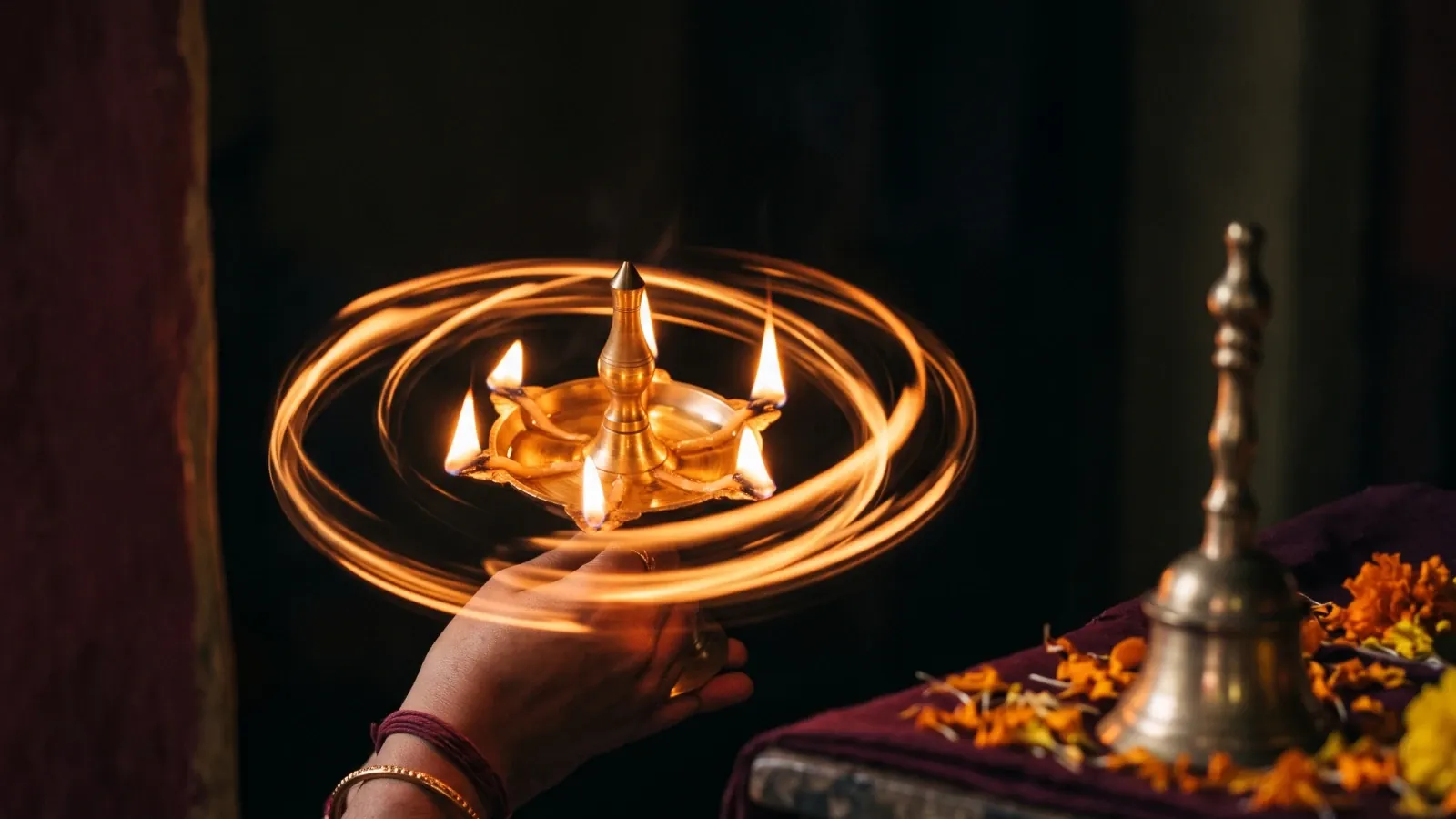
Aarti names two things at once: the ritual of waving a lit lamp, usually in clockwise circles, before a deity, and the song sung while doing it. It is often the climax of a puja, accompanied by bells and clapping. Afterwards, those present pass their palms over the flame and touch them to their eyes or forehead, receiving the blessing of the light.
"Om Jai Jagdish Hare", composed in the nineteenth century, is sung in homes and temples across north India. Each deity has its own popular aartis, and regional traditions have their own.
Bhajan, kirtan and chalisa
Bhajans and kirtans are devotional songs, often sung in groups, in every Indian language. They're part of the bhakti, or devotion, strand of Hindu practice, where love for the deity matters more than ritual precision.
A chalisa is a devotional hymn of forty verses (chalis means forty). The most famous is the Hanuman Chalisa, composed in Awadhi by the poet-saint Tulsidas, recited by millions, often on Tuesdays and Saturdays.
Where each fits in a puja
| Point in the puja | What's usually recited |
|---|---|
| Beginning | A shloka or mantra to Ganesha |
| Sankalpa | A formal Sanskrit statement (by the pandit) or your own words |
| Invocation and offerings | Mantras for each offering, in a formal puja |
| Main worship | Mantras on a mala, a stotra, or a chalisa |
| Closing | Aarti, then a prayer asking forgiveness for any mistakes |
| Anytime | Bhajans |
Our guide on how to do a simple puja at home shows these in sequence.
Getting started
- Start small. One mantra or shloka you understand is better than a long text you rush.
- Learn by listening. Pronunciation is easier to pick up from a recording or an elder than from text.
- Know the meaning. Most mantras and shlokas have widely available translations, and understanding them changes how they feel to recite.
- Follow your tradition. Families and communities have their own favourite prayers; those are a natural place to begin.
The Aroha Astrology app includes a shlokas library with audio and all 701 verses of the Bhagavad Gita. And for larger ceremonies with Vedic mantras, Aroha Puja, coming soon, will let you book a pandit at home.