Hindu tradition doesn't treat a life as one continuous stretch. It marks it with samskaras, ceremonies at key thresholds that sanctify a stage of life: a baby's name, a child's first solid food, the beginning of learning, a wedding and, finally, the rites after death. Many families still observe several of them, each with its own puja.
The sixteen samskaras
The Grihya Sutras, the classical manuals for household rites, describe the samskaras. Different texts give different lists; the one below is commonly cited.
| # | Samskara | Stage | What it marks |
|---|---|---|---|
| 1 | Garbhadhana | Before conception | Prayer for a child |
| 2 | Pumsavana | Pregnancy | Blessing for the growing baby |
| 3 | Simantonnayana | Pregnancy | Blessing the mother; today often a baby-shower ceremony |
| 4 | Jatakarma | Birth | Welcoming the newborn |
| 5 | Namakarana | Infancy | Naming |
| 6 | Nishkramana | Infancy | The baby's first outing, often to see the sun or a temple |
| 7 | Annaprashana | Infancy | First solid food |
| 8 | Chudakarana | Early childhood | First haircut (Mundan) |
| 9 | Karnavedha | Childhood | Ear piercing |
| 10 | Vidyarambha | Childhood | Beginning of learning |
| 11 | Upanayana | Childhood / youth | Sacred thread initiation, in communities that observe it |
| 12 | Vedarambha | Youth | Beginning of Vedic study |
| 13 | Keshanta | Youth | First shave |
| 14 | Samavartana | Young adulthood | Completion of studies |
| 15 | Vivaha | Adulthood | Marriage |
| 16 | Antyeshti | Death | Last rites |
Few families observe all sixteen today. Which ones are kept, and how, depends heavily on region, community and family tradition.
The ceremonies families commonly observe
Godh Bharai, Seemantham and baby showers
The pregnancy samskaras survive most visibly as celebrations for the expectant mother: Godh Bharai in much of north India, Seemantham or Valaikaappu in the south. Many include a small puja along with blessings, gifts and bangles for the mother.
Namkaran: naming
The naming ceremony is traditionally held on the eleventh or twelfth day after birth in many communities, though timing varies. The first syllable of the name is often chosen from the pada of the baby's birth Nakshatra; our list of the 27 Nakshatras explains how padas and syllables work. A short puja is followed by the name being whispered in the baby's ear and announced to the family.
Annaprashan: first solid food
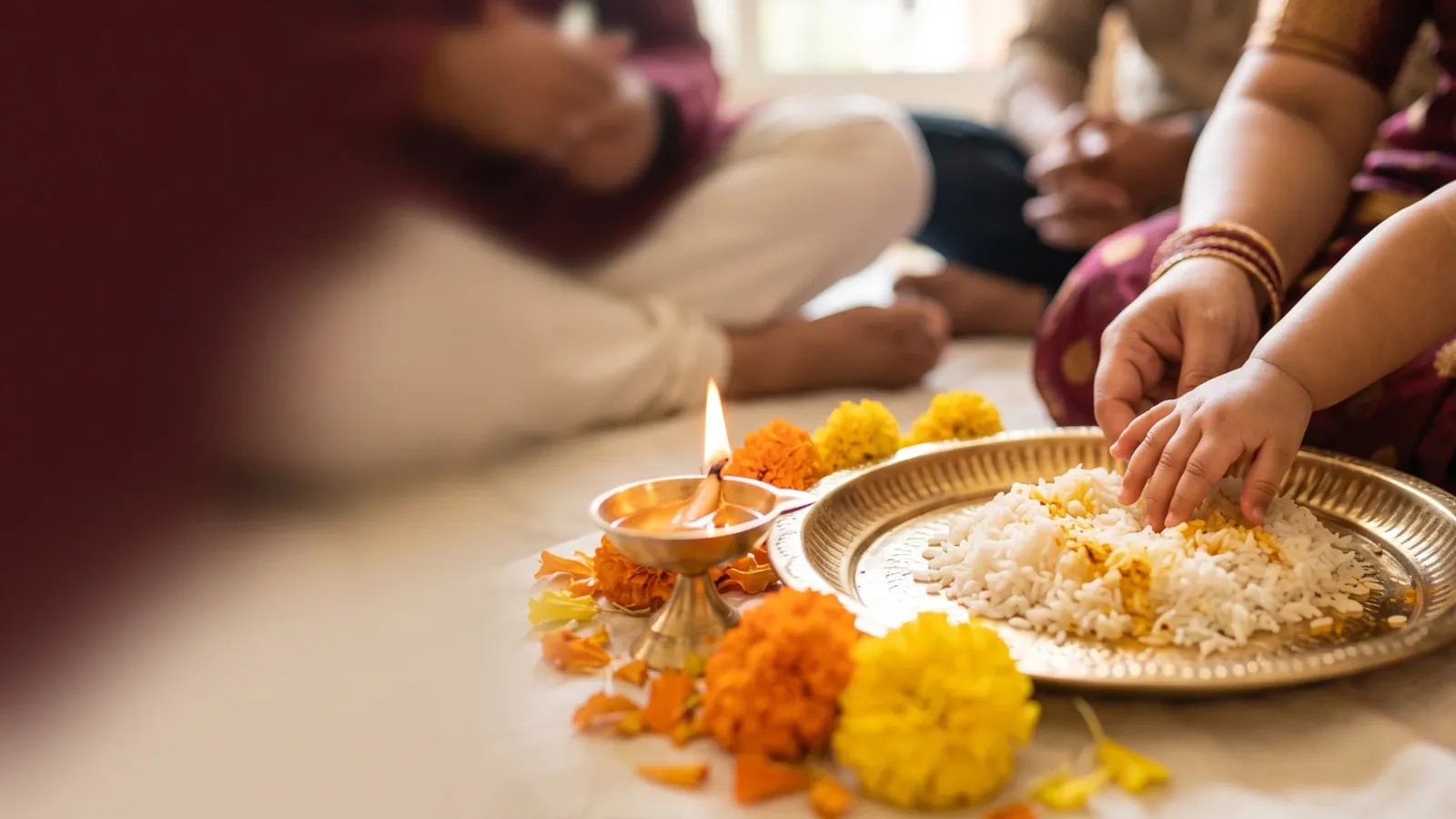
Around six months, a baby is fed a first taste of rice, often kheer, after a puja. The ceremony has regional names: Mukhe Bhaat in Bengal, Choroonu in Kerala. Some families place objects such as a book, a pen and money before the baby to see which is picked up first, a playful folk custom.
Mundan: first haircut
The first haircut is traditionally done in the first or third year (odd years are commonly preferred), often at a temple or with a puja at home. In many families the hair is offered at a temple.
Karnavedha: ear piercing
Often combined with another ceremony or done on an auspicious day in early childhood.
Vidyarambha: the start of learning
The child writes their first letters, traditionally in rice or sand, with a priest or elder guiding their hand. In Kerala and parts of South India it's celebrated widely as Vidyarambham on Vijayadashami; elsewhere it's called Aksharabhyasam or held at the start of schooling.
Upanayana
The sacred thread ceremony is observed in some communities as the start of formal religious education. Its practice and meaning are specific to those communities.
Vivaha: marriage
The wedding is the most elaborate of the samskaras, with a sequence of rites that differs enormously between regions. Many families consult a Kundli match first; see Guna Milan.
Milestone birthdays
Several later-life ceremonies, most common in South India, mark long life:
| Ceremony | Age | Meaning |
|---|---|---|
| Shashtipurti (Shashtyabdapurti) | 60 | Completing one cycle of the traditional sixty-year calendar; often includes a renewal of the couple's wedding vows |
| Bhimaratha Shanti | 70 (77 in some traditions) | A later milestone of long life |
| Sathabhishekam (Sahasra Chandra Darshan) | Around 80 | Having seen a thousand full moons |
These are occasions for the whole family, often with a havan and a large gathering.
After death
Antyeshti, the last rites, and the shraddha ceremonies for ancestors that follow, complete the cycle. They're deeply specific to each community and are almost always performed with a family priest.
Planning a milestone puja
Our guide on booking a pandit for a puja at home covers what to ask. For naming, the Aroha Astrology app's Baby Name report suggests names from a baby's birth Nakshatra.
Aroha Puja, coming soon, is being built for these moments: book a pandit for a milestone ceremony at home, with the samagri included or arranged by your family.