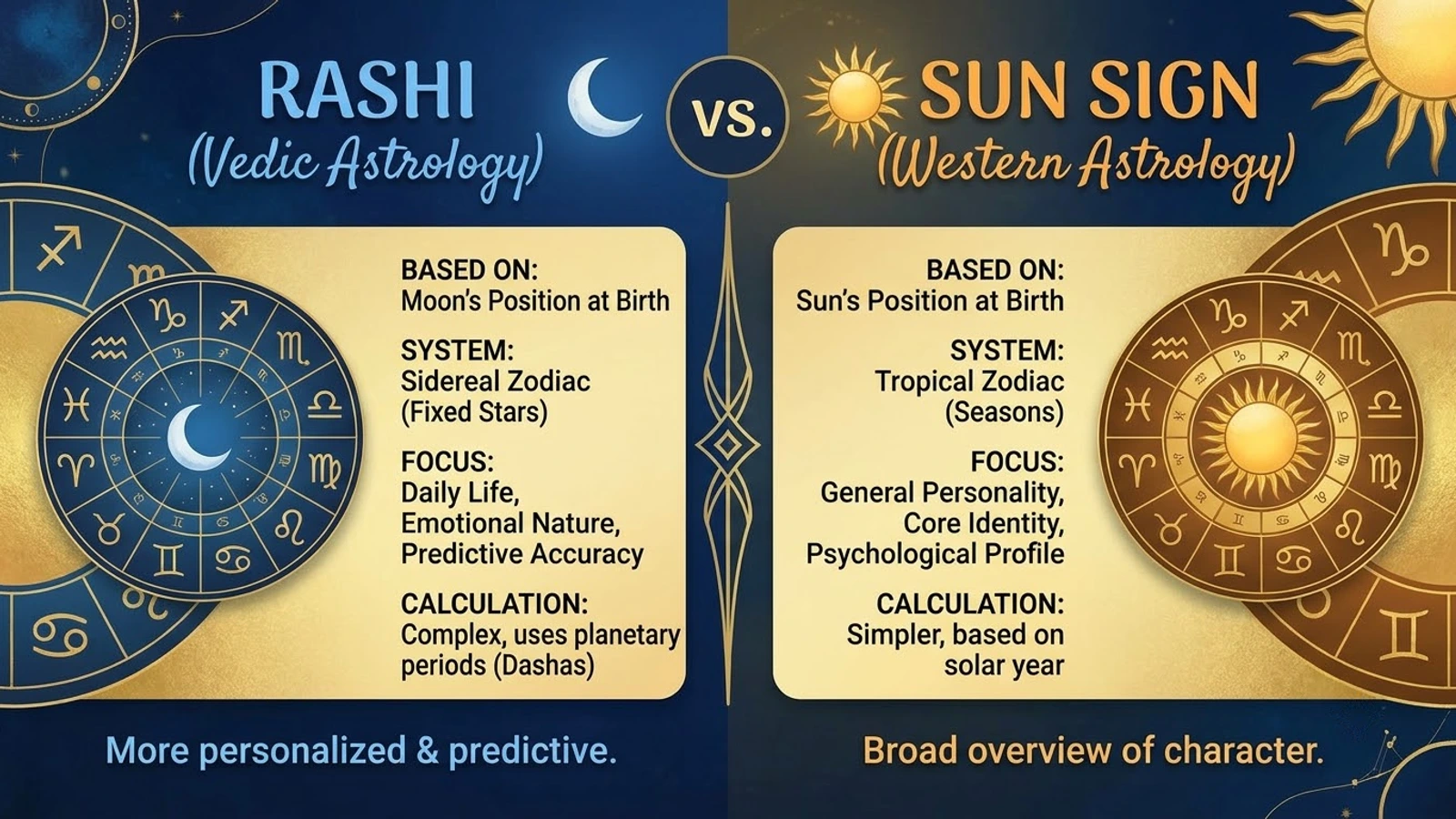
If you've ever calculated your Vedic Rashi and found it doesn't match the Sun sign you've always identified with, you haven't made a mistake, and neither has your astrologer. You've simply run into the single biggest technical difference between Western and Vedic astrology: they don't use the same zodiac.
Two different zodiacs, both internally consistent
Western astrology uses the tropical zodiac. This system is anchored to the seasons, not the stars: 0° Aries is defined as the exact moment of the spring equinox, every year, regardless of which constellation the Sun actually appears in front of at that moment. It's a seasonal coordinate system laid over the sky.
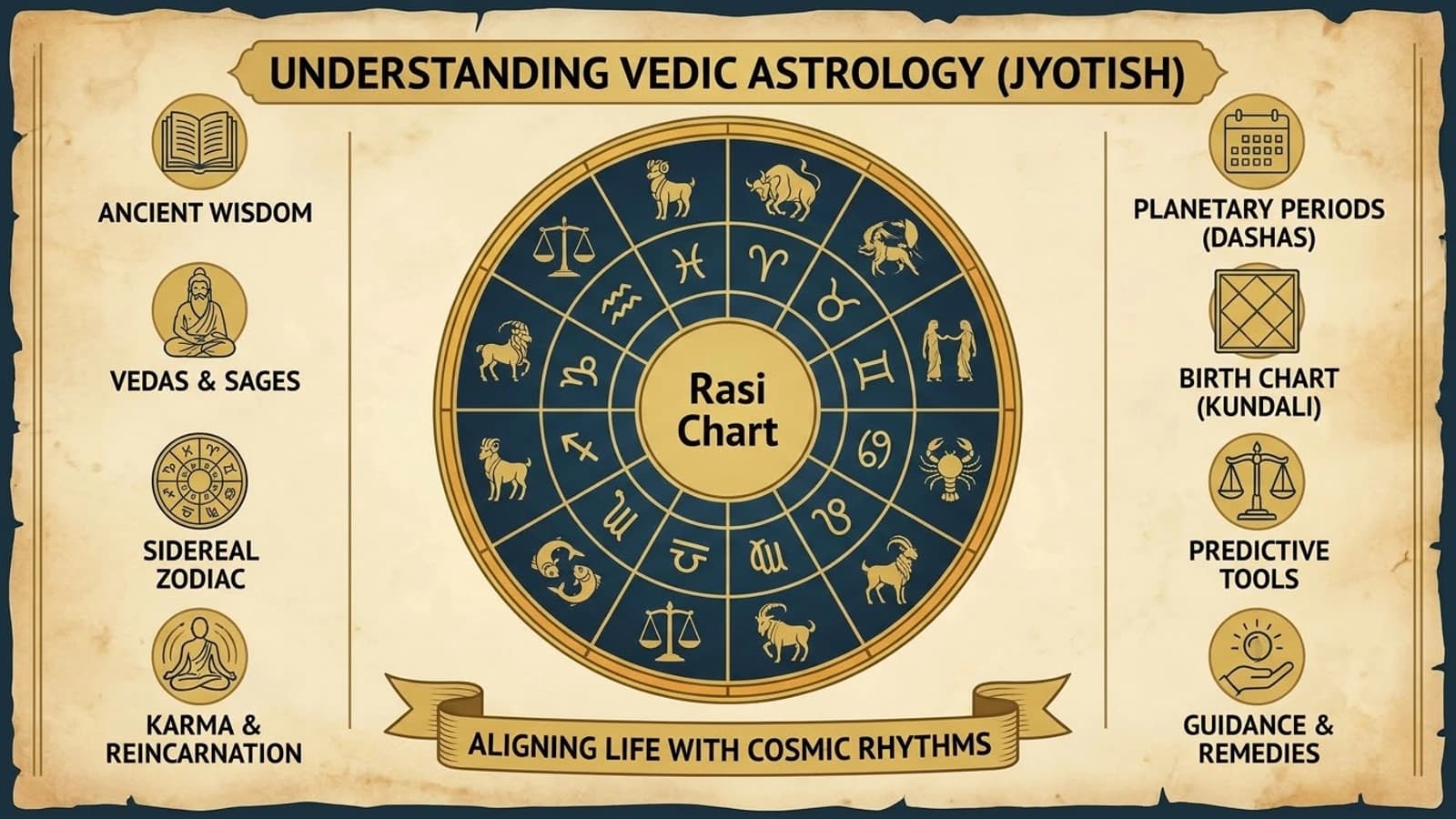
Vedic astrology uses the sidereal zodiac. This system is anchored to the actual, observable constellations, the fixed background of stars. 0° Aries here means the Sun is genuinely aligned with the start of the constellation Aries, as seen from Earth.
Both systems are internally coherent and have been used consistently for centuries within their own traditions. The two systems disagree because they answer two different questions: "where is the Sun relative to the seasons?" versus "where is the Sun relative to the stars?"
Why they've drifted apart: precession
Thousands of years ago, the tropical and sidereal zodiacs were closely aligned. They no longer are, because of a slow wobble in Earth's axis of rotation called axial precession. Much like a spinning top that gradually tilts its axis in a circle, Earth's axis traces a full circle over roughly 26,000 years. As it does, the point in the sky that marks the spring equinox slowly shifts backward against the fixed constellations.
Because the tropical zodiac is pinned to the equinox and the sidereal zodiac is pinned to the constellations, this precession causes the two systems to drift apart, year over year, at a slow but entirely measurable rate.
The ayanamsa: measuring the gap
The angular gap between the tropical and sidereal zodiacs at any given moment is called the ayanamsa (literally "the movement of the equinox"). Today, that gap is roughly 24 degrees, nearly a full zodiac sign's worth of separation, since each sign spans 30 degrees.
Different sidereal traditions calculate the ayanamsa slightly differently, but the one used as the official standard by India's government astronomical almanac (the Indian Astronomical Ephemeris) is the Lahiri ayanamsa, named after the astronomer N.C. Lahiri. It's the reference correction that most Vedic astrology software, including proper Kundli calculations, applies when converting a birth chart from tropical to sidereal positions.
The practical consequence
Because the current ayanamsa is close to 24 degrees, nearly a full sign, a person's Western tropical Sun sign is very often exactly one sign "behind" their Vedic sidereal Sun sign. Someone who has always identified as a Western Aries will frequently find their Vedic Rashi is Pisces; a Western Leo is often a Vedic Cancer; and so on. This isn't universal. The exact shift depends on how close your birthday falls to a sign boundary in each system, but it's the general pattern behind almost every "wait, my Vedic sign is different?" moment.
Your Rashi and Sun sign are only two of the three core placements Vedic astrology starts from. See what your Lagna (Ascendant) adds to complete the picture.
See your own sidereal placements
The only way to know where you actually fall in each system is to have both calculated properly for your exact birth details, rather than assuming a fixed offset. See your real sidereal placements and compare them with the Western tropical signs you may already know.