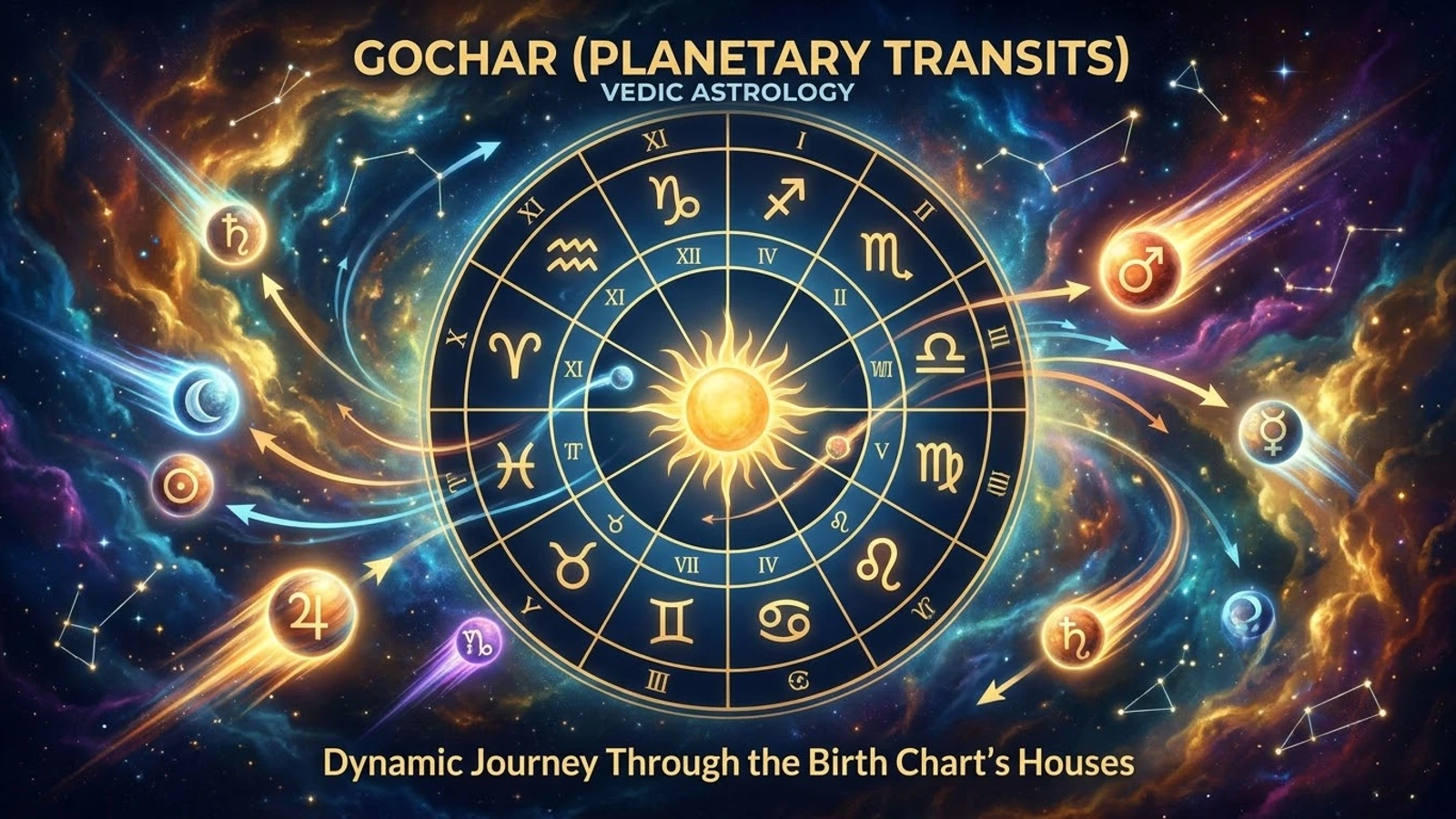
Gochar is Vedic astrology's name for transit: the planets' present positions in the sky, read against the birth chart you were born with. Your chart never changes, but the planets keep moving, and gochar asks which of your houses they are crossing now.
What Gochar compares
Gochar always sets two things side by side. The natal chart holds the planetary positions at the moment of your birth, and those stay fixed. The transit chart holds where the same planets are today, and those change every day. An astrologer places the transiting planets onto your natal chart and notes which house each one is passing through, then reads what that house governs. Because the sky is the same for everyone, two people with different charts get different readings from the same transit. A Saturn transit that crosses one person's 10th house crosses another's 4th. See the 12 houses guide for what each house covers.
Count from the Moon
Classical gochar counts houses from the natal Moon sign, a method called Chandra Lagna, which is why your Moon sign is the first thing to know. If your Moon is in Cancer, Saturn passing through Libra is counted as the 4th house from the Moon. Many astrologers read the same transit twice, once from the Moon and once from the Lagna, and give more weight where the two agree. You can find your Moon sign free, and the Moon sign guide explains why it is the starting point.
How long each planet stays in a sign
Speed decides how much a transit can matter, and the times below are approximate.
Saturn stays about two and a half years in a sign and takes about 29.5 years to complete the zodiac. Jupiter stays about a year. Rahu and Ketu move backward through the zodiac and stay about eighteen months in a sign. Mars stays around a month and a half. The Sun stays about a month, Venus and Mercury somewhere between a few weeks and a couple of months depending on retrograde motion, and the Moon about two and a quarter days.
A fast planet's transit is over in days, so astrologers use the Moon and inner planets to describe the mood of a day or a month. The slow planets shape long themes, which is why Saturn, Jupiter and the nodes get the most attention.
Favourable and unfavourable houses
Gochar texts list the houses from the Moon in which each planet is traditionally considered to give good results. In the commonly taught tables, Jupiter is favourable in the 2nd, 5th, 7th, 9th and 11th houses from the Moon, and Saturn in the 3rd, 6th and 11th. The tables also note that a favourable transit can be blocked by a planet in a certain opposing house, a rule called vedha. Saturn's most discussed passage is Sade Sati, the three signs around the natal Moon. These tables are a tradition's rules of thumb, and astrologers weigh them against the whole chart.
Retrograde motion
A planet that appears to move backward spends longer in a sign, and it can step back into the sign it just left. That is why a transit's start and end dates come from computed planetary motion and not from a fixed countdown. The retrograde planets guide explains what Vedic astrology says about each one.
Transit and Dasha together
Transits are rarely read alone. The Dasha says which planet's themes are active in your life at the moment, and a transit shows what is currently triggering them. A Saturn transit over a sensitive house carries more weight when Saturn also rules the running period. For the timing side, see the Vimshottari Dasha guide and the Mahadasha, Antardasha and Pratyantar guide.
The slow transits of 2027
Three slow movements shape 2027. Saturn is in Pisces, visits Aries from 3 June to 19 October, and returns to Pisces. Jupiter goes back into Cancer on 25 January, returns to Leo on 26 June and enters Virgo on 26 November. Rahu and Ketu stay in Capricorn and Cancer all year. Each has a page with exact dates and the house from every Moon sign: Saturn, Jupiter and Rahu and Ketu.
Track your own transits
A meaningful transit reading starts with an accurate natal chart to compare against. Generate your free Kundli with Aroha Astrology to get your Lagna and Moon sign, the two reference points for every transit.