Open any Panchang app during a Mercury retrograde season and you'll see warnings about miscommunication and delayed travel. Vedic astrology takes retrograde motion seriously too, but the classical reading is more nuanced than "good" or "bad," and depends heavily on which planet, in which sign and house, is involved.
What Does Retrograde Mean?
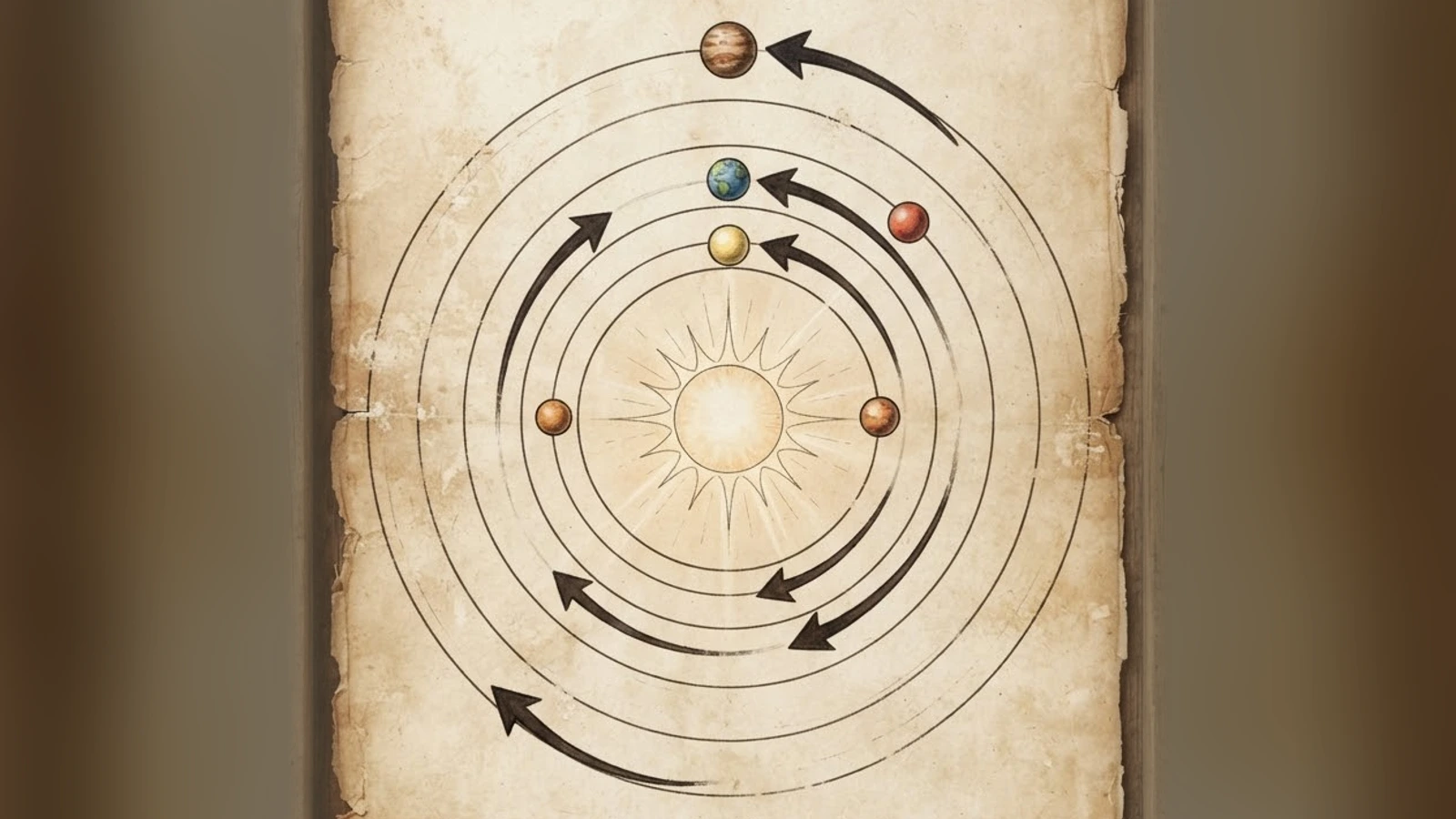
A retrograde planet appears to move backward through the zodiac as seen from Earth, tracing an apparent loop against the background stars instead of its usual forward path.
Why Planets Appear Retrograde
This is an optical effect of relative orbital speed, not an actual reversal in the planet's real motion around the Sun. As Earth overtakes a slower outer planet (or is overtaken by a faster inner one), that planet appears to slow, stop, and briefly move backward from our vantage point, before resuming its normal forward motion.
Which Planets Can Be Retrograde?
Mercury, Venus, Mars, Jupiter and Saturn all go retrograde periodically, each on its own cycle: Mercury several times a year, the outer planets for a period lasting months. The Sun and Moon never appear retrograde from Earth.
What Is Vakri in Vedic Astrology?
Vakri is the Sanskrit term for a retrograde planet: a specific, named condition in classical Jyotish, distinct from a planet's sign, house or dignity, but read alongside all of them rather than in isolation.
Does Retrograde Always Mean Weak?
No. It is one of the more common oversimplifications in casual astrology content. "Retrograde means the planet becomes stronger" is just as much an oversimplification as "retrograde means weak." Neither is a rule you can apply on its own. Some traditional readings associate a retrograde planet with heightened or unusual expression of its significations, but that reading is still filtered entirely through the planet's sign placement, house, dignity, aspects, conjunctions and lordship: a retrograde planet that's also debilitated and afflicted doesn't get a free pass, and an already well-placed planet going retrograde isn't automatically weakened either.
How Retrogression Changes Planetary Expression
Retrograde Mercury
Traditionally linked to a more internal, reconsidering quality of mind: communication and decision-making that circle back and revise rather than move in a straight line, rather than a wholesale communication failure.
Retrograde Venus
Often read as relationships and aesthetic taste that revisit the past: reconnecting with an earlier relationship or reworking one's sense of what's valued, rather than a simple negative for love or finances.
Retrograde Mars
Traditionally associated with energy and drive that turns inward rather than outward: action that's deliberated over rather than impulsive, which can read as hesitation or as unusual persistence depending on the rest of the chart.
Retrograde Jupiter
Traditionally linked to wisdom and belief systems that are reconsidered and internalised rather than simply absorbed from outside: a more self-directed relationship with knowledge, growth or philosophy.
Retrograde Saturn
One of the most discussed retrograde placements: traditionally read as discipline and responsibility that are worked through internally, sometimes described as intensifying Saturn's lessons rather than softening them. Not inherently "bad," but a placement worth reading carefully alongside Saturn's house and sign, the same way any Saturn placement is. See exalted and debilitated planets for how sign dignity factors in.
What About Rahu and Ketu?
The lunar nodes, Rahu and Ketu, are calculated mathematical points rather than physical bodies, and by their nature they move backward through the zodiac essentially all the time. Convention treats them as permanently retrograde, which means "retrograde Rahu" isn't read as a distinct condition the way retrograde Mercury or Saturn is: there's no meaningful forward-motion state to compare it against.
Retrograde in Natal Charts vs. Transits
A planet retrograde in your birth chart is a fixed, lifelong placement, read as part of your permanent chart, the same as any sign or house position. A planet turning retrograde in transit (Gochar) is temporary, and traditionally treated as a period where that planet's significations in your chart get revisited or reworked rather than newly initiated. See planetary transits for how transit reading generally works.
Common Myths About Retrograde Planets
- "Retrograde planets are cursed": no classical basis for treating retrograde as inherently malefic.
- "Every Mercury retrograde will cause chaos for everyone": a transit's actual effect depends on which houses and planets it activates in your specific chart, not a universal outcome.
- "A retrograde planet in the birth chart is a lifelong weakness": as covered above, its actual strength depends on sign, house, dignity and aspects, not retrogression alone.
How to Interpret a Retrograde Planet Correctly
Read retrogression as one more layer of context on top of a planet's placement, never as a standalone verdict. The same planet, retrograde, in two different charts can read very differently depending on its sign, house, dignity, aspects, conjunctions, lordship, its position in divisional charts, and whether its dasha is currently active.
Frequently Asked Questions
Is a retrograde planet always weak?
No. Retrograde is a motion condition, not a strength rating on its own, a retrograde planet's actual reading depends on its sign, house, dignity, aspects and the dasha it activates in, the same way any other placement does.
Can Rahu and Ketu be retrograde?
By convention they're treated as always retrograde in Vedic astrology, since the lunar nodes are calculated points that move backward through the zodiac by nature, so "retrograde Rahu" isn't a distinct, separately meaningful condition the way it is for the other seven grahas.
Does retrograde mean the planet is more powerful?
Not automatically, and not universally. This is one of the more common oversimplifications online. Some traditional views associate retrogression with a planet acting with unusual intensity or introspection, but that's still shaped by the planet's sign, house and dignity, not a blanket rule that retrograde equals stronger.
See your retrograde planets
Generate your free Kundli with Aroha Astrology to see which of your planets are retrograde, and how that fits into their sign, house and dignity in your actual chart.