If you already know the basics, a Mahadasha sets the broad theme for years at a stretch, and an Antardasha modifies it within that. See how to read your Vimshottari Dasha for that primer first. This guide picks up from there: the third level down, how all three levels combine into one working timeline, and what actually determines whether a given period reads as supportive or difficult.
Quick Recap: Mahadasha and Antardasha
Your Mahadasha is the ruling planetary period you're in: nine possible planets, lasting anywhere from 6 to 20 years each, determined by your Moon's Nakshatra at birth. Within it, your Antardasha is a sub-period, cycling through the same nine planets in the same fixed order, starting with the Mahadasha lord itself. The full mechanics (including why the sequence always starts where it does and how sub-period length is calculated) are covered in the Vimshottari Dasha guide.
What Is a Pratyantar Dasha?
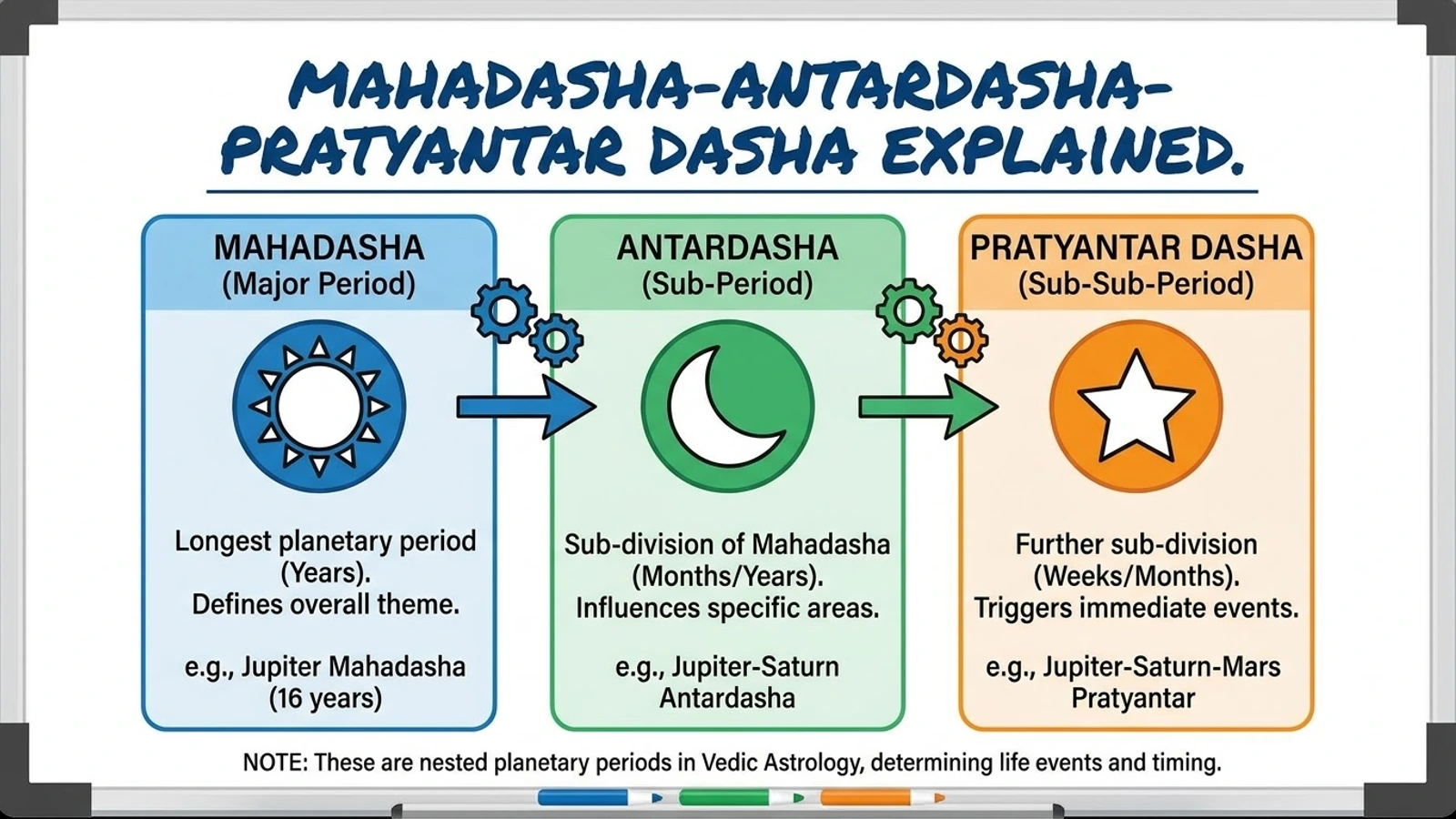
A Pratyantar Dasha is the third level: a sub-period within an Antardasha, the same way an Antardasha is a sub-period within a Mahadasha. It's calculated identically to the level above it: proportionally, using the same fixed Vimshottari order (Ketu → Venus → Sun → Moon → Mars → Rahu → Jupiter → Saturn → Mercury), starting with the Antardasha's own lord and cycling through from there, with each Pratyantar's length weighted by both the Antardasha's total length and the sub-lord's own share of the 120-year cycle.
How the Three-Level Hierarchy Works
Think of it as three nested clocks running at different speeds. The Mahadasha sets the years-long theme. The Antardasha, running inside it, modifies that theme every few months to a couple of years. The Pratyantar, running inside the Antardasha, narrows it further, often down to a matter of weeks. All three are active simultaneously: at any given moment, you're in exactly one Mahadasha, one Antardasha within it, and one Pratyantar within that.
A Worked Example
Take someone in their Saturn Mahadasha. Within it, they're currently in a Saturn-Venus Antardasha: Saturn's own broad theme, modified by Venus's significations (relationships, comfort, aesthetics). Within that Antardasha, the Pratyantar sequence starts with Venus itself (Saturn-Venus-Venus), then moves to Saturn-Venus-Sun, then Saturn-Venus-Moon, and onward through the same nine-planet order. A Saturn-Venus-Jupiter Pratyantar (Saturn's discipline, filtered through Venus's relationship focus, further coloured by Jupiter's growth-and-expansion signature) reads differently from a Saturn-Venus-Rahu Pratyantar just a few weeks later in the same Antardasha, even though both sit inside the identical Saturn-Venus period.
How Long Are the Different Periods?
Mahadashas range from 6 years (Ketu) to 20 years (Venus). Antardashas within them typically run from a few months to a couple of years, depending on both the Mahadasha's total length and the Antardasha lord's own weight in the cycle. Pratyantar Dashas are shorter again, commonly a matter of weeks to a few months, since they subdivide an already-short Antardasha using the same proportional method one level further down.
What Determines Whether a Dasha Gives Good Results?
Which planets are ruling at each level matters less on its own than what those planets are actually doing in your specific chart.
Planetary Strength
A planet's own dignity (exalted, own-sign, debilitated, or combust) shapes how favourably its ruling period tends to read. See exalted and debilitated planets and combust planets.
House Ownership
Which houses a planet rules matters enormously: a planet ruling houses traditionally considered favourable (like the 1st, 5th, 9th or 10th) tends to give a different flavour of period than one ruling more difficult houses.
House Placement
Where the ruling planet actually sits, which house it occupies, colours what area of life its period tends to activate.
Aspects and Conjunctions
Benefic aspects and conjunctions on the ruling planet traditionally soften a period; malefic ones traditionally add friction. See planetary aspects (drishti).
Divisional Charts
A planet's strength in relevant divisional charts (the Navamsa for general strength, the Dasamsa for career-linked periods, and so on) is traditionally weighed alongside its main-chart (D1) placement.
Transits
Even a well-supported Dasha period is read alongside what's happening in transit (Gochar) at the same time. See planetary transits explained. A supportive Dasha combined with a difficult transit, or vice versa, produces a more layered result than either factor alone would suggest.
Common Mistakes When Reading Dashas
- Judging a period by the Mahadasha planet alone, ignoring the Antardasha and Pratyantar actually running underneath it.
- Assuming a "benefic" planet's period is automatically easy, or a "malefic" planet's period automatically hard, without checking that planet's actual dignity and house role in the specific chart.
- Ignoring transits entirely and reading Dasha in isolation.
- Treating Pratyantar-level timing as necessary for every question, when Mahadasha and Antardasha are usually sufficient for broad life-direction reading.
Frequently Asked Questions
What is a Pratyantar Dasha?
It's the third level of the Vimshottari Dasha hierarchy: a sub-period within an Antardasha, itself a sub-period within a Mahadasha. It's calculated the same way each level down is: proportionally, using the same fixed nine-planet Vimshottari sequence and each planet's share of the 120-year cycle.
Do I need to know my Pratyantar Dasha for everyday reading?
Not usually. Mahadasha and Antardasha are enough for most broad-strokes timing. Pratyantar becomes useful when you're narrowing down a specific window for a specific event, since it's the level that divides a period down to a matter of weeks or months rather than years.
What makes a Dasha period "good" versus "difficult"?
No single factor decides this. It comes from weighing the ruling planets' strength, which houses they own and sit in, their aspects and conjunctions, their placement in relevant divisional charts, and what's happening in transit at the same time. The same planet's dasha can read very differently for two different people.
See your full Dasha timeline
Your Mahadasha, Antardasha and Pratyantar sequence is entirely determined by your birth chart. Explore your real timeline in your to see exactly which three-level period you're in right now.