Ask a Vedic astrologer when something is likely to happen in your life (a career shift, a marriage, a health concern) and the answer almost always comes from one tool: the Vimshottari Dasha. It's the timing system underneath most predictive Jyotish, and once you know how to read it, a Kundli stops being a static snapshot and starts reading like a timeline.
A 120-year cycle
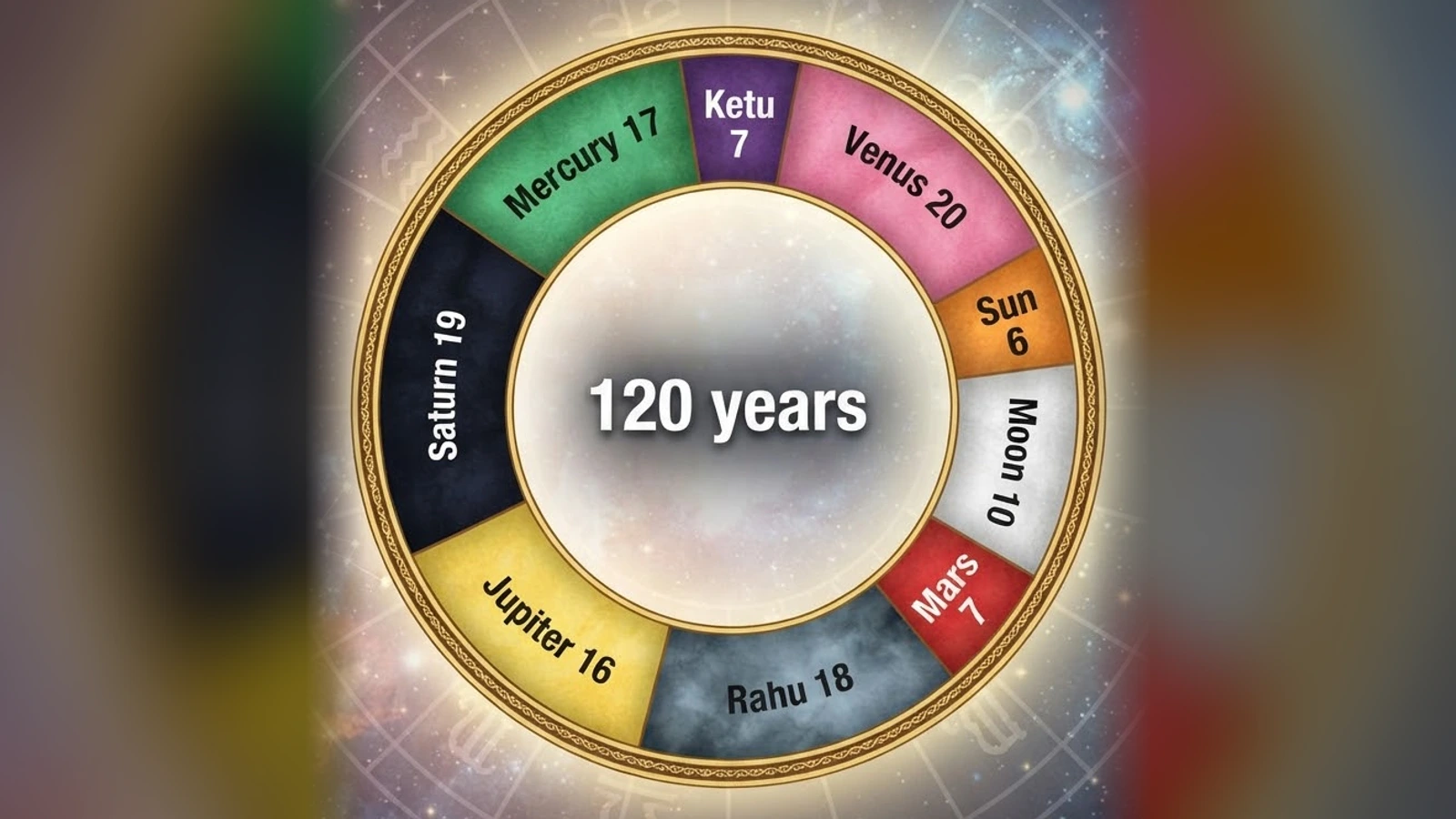
"Vimshottari" means "one hundred and twenty" in Sanskrit, and that's exactly the length of the full cycle: 120 years, treated in classical Jyotish as a person's complete lifetime reckoning. That 120-year span is divided, in a fixed sequence, into nine periods called Mahadashas: one "great period" ruled by each of the nine grahas (planets) used in Vedic astrology.
The order and length of each Mahadasha never changes, and the nine periods add up to exactly 120 years:
- Ketu: 7 years
- Venus: 20 years
- Sun: 6 years
- Moon: 10 years
- Mars: 7 years
- Rahu: 18 years
- Jupiter: 16 years
- Saturn: 19 years
- Mercury: 17 years
Notice the asymmetry: Venus gets a generous 20-year run, while the Sun's Mahadasha lasts only 6. This isn't arbitrary; it reflects the traditional weighting each planet carries in the system.
Why your birth Moon decides where you start
Nobody starts at Ketu and simply counts forward from age zero. Instead, the Mahadasha you're born into, and how far into it you already are at birth, is determined by the exact position of the Moon in the 27 Nakshatras at the moment of your birth.
Each of the 27 Nakshatras is assigned a ruling planet, and the nine planetary rulers repeat in the same fixed Vimshottari order across the 27 Nakshatras (three full cycles of nine). Whichever Nakshatra your Moon occupied at birth tells the system which planet's Mahadasha you were born into, and your Moon's precise degree within that Nakshatra determines how much of that first Mahadasha had already "elapsed" before you were born, versus how much of it you have left to run. This is, once again, why an accurate birth time is essential: shift the birth time enough to move the Moon into a different Nakshatra, and the entire Dasha timeline recalculates from a different starting point.
Antardashas: sub-periods within each Mahadasha
Each Mahadasha is further divided into nine Antardashas (sub-periods). The sequence always starts with the Mahadasha's own lord, then continues in the same fixed Vimshottari order (Ketu → Venus → Sun → Moon → Mars → Rahu → Jupiter → Saturn → Mercury, wrapping back to Ketu) picking up right after that lord, with each Antardasha's length calculated proportionally to both the ruling Mahadasha's length and the sub-lord's own weight in the 120-year cycle.
For example, someone currently in their Saturn Mahadasha (19 years total) opens with a Saturn-Saturn Antardasha, then Saturn-Mercury, then Saturn-Ketu, and onward through the same nine-planet order, before the next Mahadasha begins. Each Antardasha carries the combined character of both its Mahadasha lord and its own sub-lord: a Saturn-Jupiter period reads very differently from a Saturn-Rahu period, even though both fall inside the same 19-year Saturn Mahadasha.
For the next level down, Pratyantar Dashas, and a worked three-level example, see Mahadasha, Antardasha and Pratyantar Dasha Explained.
What the timeline is used for
Classical Jyotish practice uses the specific combination of Mahadasha and Antardasha, sometimes narrowed further into a third-level sub-sub-period, to judge when a particular life theme is likely to become active: a career-significant planet's Dasha activating around a promotion, a relationship-significant planet's Dasha lining up with a marriage, or a health-related placement's Dasha coinciding with a period requiring more care. The natal chart shows what is possible; the Dasha timeline is the traditional method for estimating when.
Dasha timing is one piece of a full reading. See how to read your Vedic birth chart step by step for where it fits alongside your houses, yogas and transits.
See your own Dasha timeline
Your Mahadasha and Antardasha sequence is entirely determined by your birth chart, calculated from your exact birth details. Explore your real Dasha timeline in your to see which periods you're in now and what's ahead.