Every Vastu text begins with the site. The ground a home stands on is, in the tradition, presided over by the Vastu Purusha and the deities who are said to rest on him. Vastu Shanti, "peace for the dwelling", is the ceremony that honours them: a puja, usually with a havan, asking that the home and its household be in harmony.
The idea behind it
In the story at the root of Vastu Shastra, a vast being was pinned to the earth by the gods, who then settled on his body; he became the Vastu Purusha, and each part of a site became associated with a deity. The Vastu Purusha Mandala, the grid that underlies Vastu planning, maps those deities onto the plan. Our guide to what Vastu Shastra is explains this in more detail.
Building on a site, digging into it and altering it are, in this tradition, acts that should be accompanied by respect and offerings to those deities. Vastu Shanti is that offering.
When families perform it
| Occasion | Why, traditionally |
|---|---|
| Before moving into a new home | To bless the site before living there; often combined with Griha Pravesh |
| After major renovation or rebuilding | Because the site has been disturbed |
| Moving into an older or long-vacant house | To begin afresh in a home with a history |
| When a home departs from Vastu ideals | As a traditional propitiation where the layout can't practically be changed |
| Periodically | Some families repeat it at intervals, or on a significant anniversary |
What happens in a Vastu Shanti
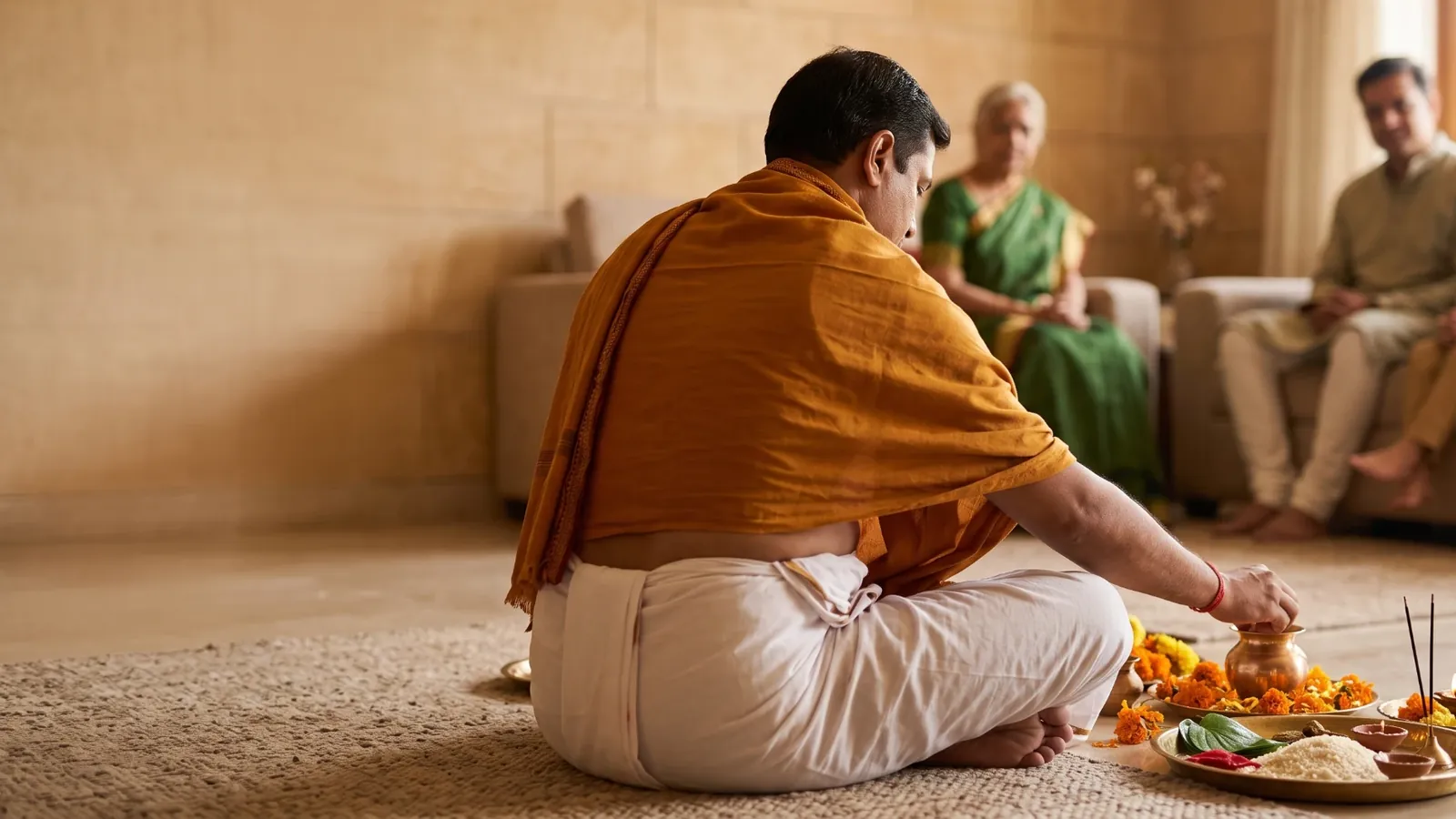
The procedure varies by region and priestly tradition. A common sequence:
- 1
Ganesh puja and sankalpa
The priest begins with Ganesha and a formal statement of who is performing the ceremony, for which home and why.
- 2
Purification
Water is consecrated and sprinkled through the home. In many South Indian traditions this is called Punyahavachanam.
- 3
Kalash sthapana
One or more kalashas are set up and consecrated as seats for the deities being invited.
- 4
Vastu mandala puja
A Vastu mandala is drawn with rice or coloured powder, its squares representing the deities of the site, and each is worshipped. The Vastu Purusha is honoured at its centre.
- 5
Navagraha puja
Many priests also worship the nine planets as part of the ceremony.
- 6
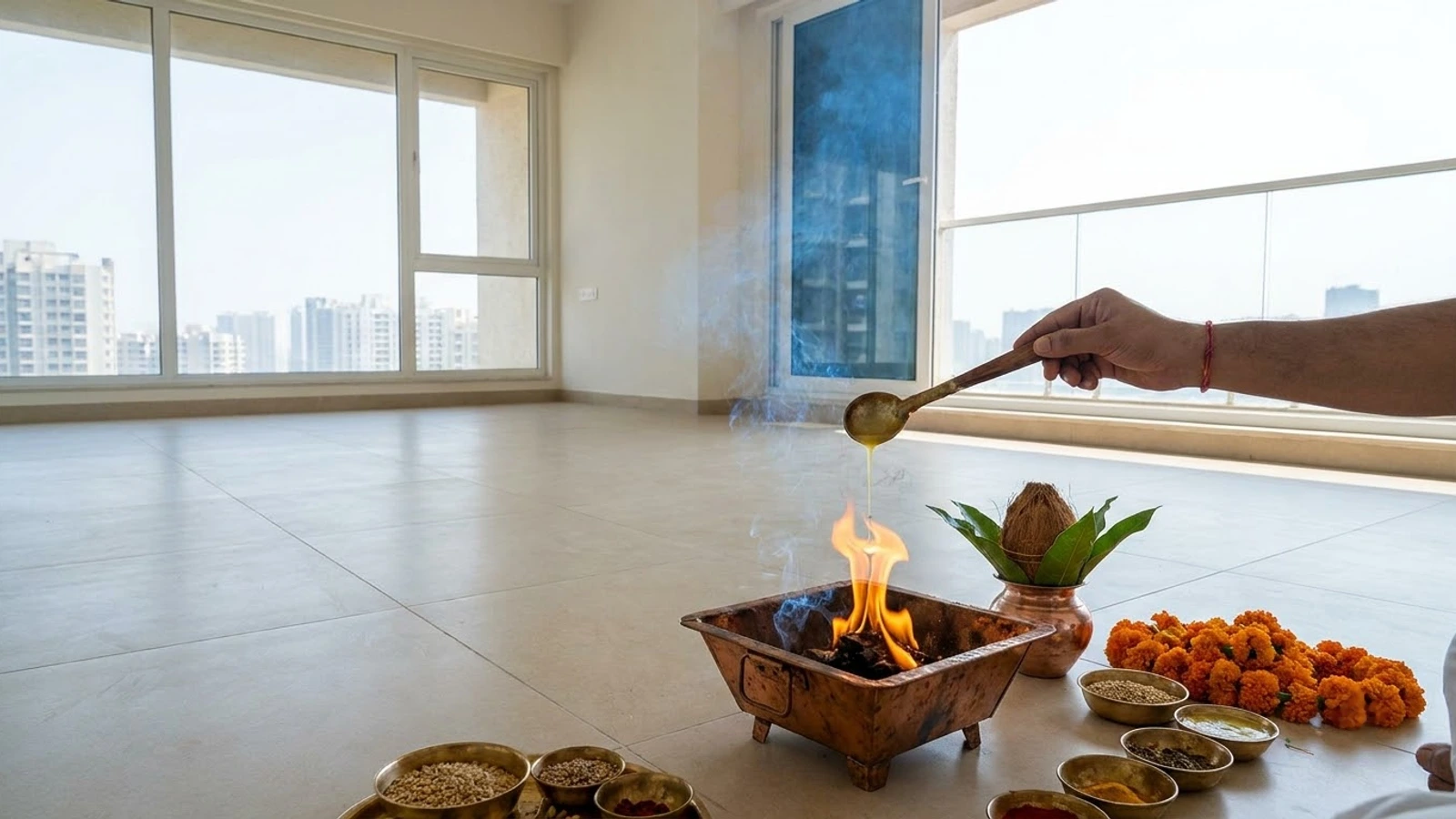
Vastu homa
A havan is performed, with offerings of ghee, grains and herbs made into the fire with Vastu mantras.
- 7
Offerings around the home
In some traditions, offerings are placed in the directions or corners of the home, and consecrated water is sprinkled in each room.
- 8
Aarti and prasad
The ceremony ends with aarti, prasad and dakshina for the priest.
It usually takes two to four hours, longer if combined with Griha Pravesh and other pujas.
Vastu Shanti and Griha Pravesh compared
| Vastu Shanti | Griha Pravesh | |
|---|---|---|
| Focus | The site and its deities | The family's first entry into the home |
| Core rites | Vastu mandala puja, Vastu homa | Ganesh puja, Kalash, ceremonial entry, milk boiling |
| When | New home, renovation, older house | Moving in |
| Performed together? | Often, as part of Griha Pravesh | Often includes a Vastu puja or full Vastu Shanti |
What it can and can't do
Vastu Shanti is sometimes sold as a cure.
In tradition, Vastu Shanti propitiates the site, and many families find real meaning in blessing a home before living in it. What it isn't is a change to the building. It doesn't move a toilet out of the north-east or bring light into a dark room. Practical issues are best handled practically; see common Vastu mistakes for what's worth acting on. And no ceremony should be sold on the promise that, without it, harm will come to your family.
Preparing for it
- Book the pandit and confirm the procedure your tradition follows, how long it will take and whether they include a havan.
- Ask who arranges the samagri. A Vastu Shanti needs more than a simple puja: typically kalashas, coconuts, mango leaves, rice and coloured powders for the mandala, flowers, ghee, havan wood and samagri, navadhanya (nine grains), fruits and sweets. See our samagri guide.
- Clear a space large enough for the mandala and havan kund, ideally near the centre or in the north-east, as your pandit advises.
- In a flat: plan for smoke with ventilation or a smaller havan, check smoke detectors, and keep water nearby.
Our guide on booking a pandit lists the questions worth asking in advance.
Aroha Puja, coming soon, will let you book a pandit for a Vastu Shanti or Griha Pravesh at home, with the samagri included or arranged by your family.