"Dosha" is one of the most anxiety-inducing words in casual astrology conversation, and one of the most misused. A dosha is a specific, defined planetary combination, not a catch-all label for "something is wrong with this chart." This guide covers what the commonly discussed doshas actually mean.
What Does Dosha Mean in Vedic Astrology?
Literally, "dosha" means a flaw or fault. In chart terms, a specific planetary combination classical texts flag as needing extra attention, whether through awareness, timing, or traditional remedial measures.
Does Every Dosha Mean Something Bad?
Not in the absolute sense casual use of the word often implies. A dosha points to an area of the chart that traditionally benefits from closer reading and, in many cases, specific remedies, not a guaranteed negative outcome regardless of the rest of the chart.
Manglik Dosha
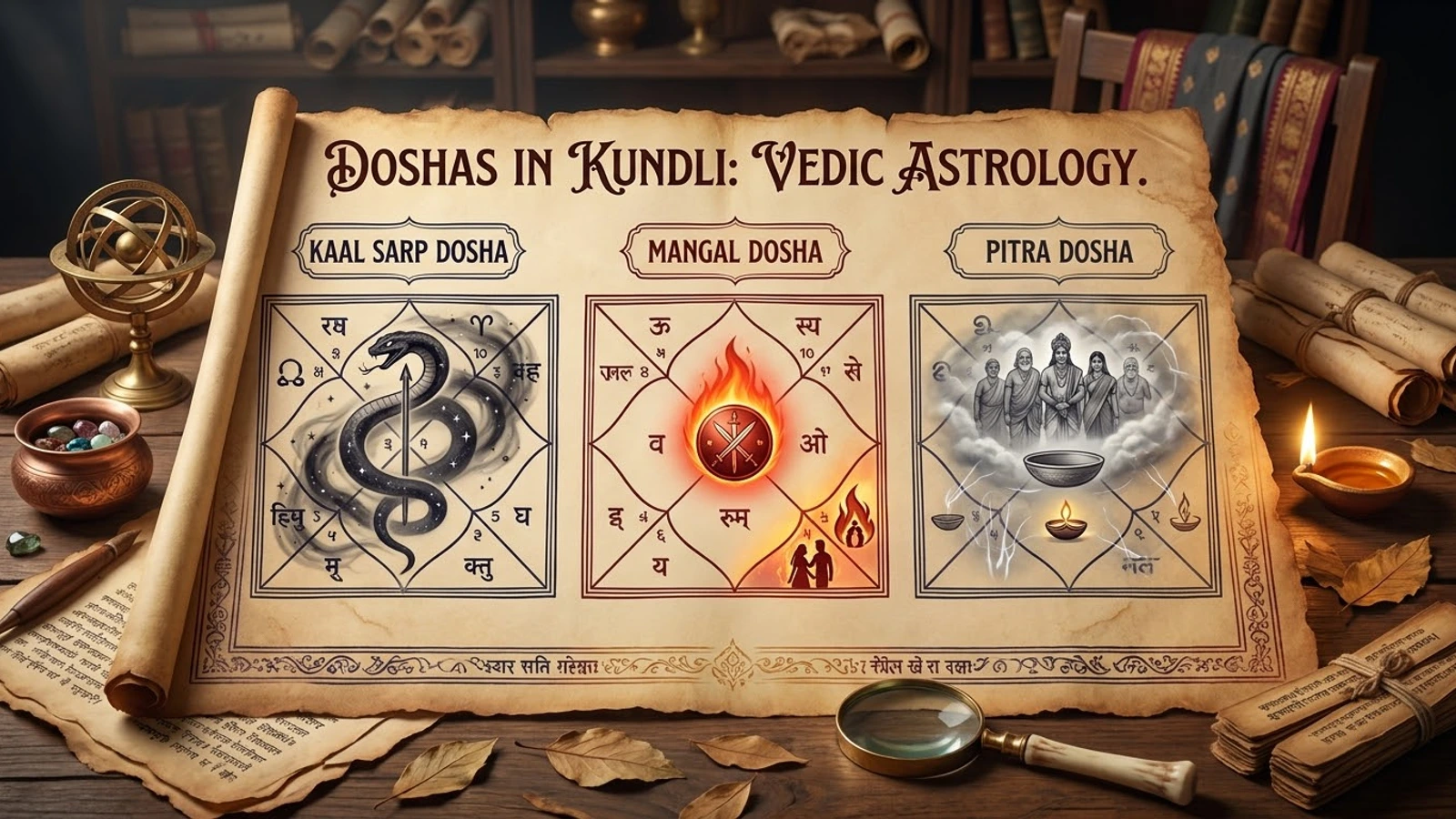
The most widely discussed dosha, formed when Mars sits in specific houses relative to the Lagna or Moon, traditionally linked to friction in marriage, and carrying well-documented classical cancellation conditions. See the full Manglik Dosha guide for how it's identified and when it's considered cancelled.
Kaal Sarp Yoga: Why Interpretations Differ
Kaal Sarp Yoga forms when all seven classical planets fall between Rahu and Ketu on one side of the chart. It's one of the more debated combinations in modern astrology: some practitioners treat it as a significant, life-shaping combination requiring specific remedies; others consider it far less consequential than popular astrology content suggests, or reject giving it special standing at all. Given that range of serious disagreement among practitioners, it's worth treating any strong claim about Kaal Sarp Yoga, in either direction, with some caution.
Pitra Dosha
Traditionally linked to unresolved ancestral or familial karma, generally read from affliction to the 9th house, its lord, or the Sun in certain contexts, associated in classical reading with the idea that certain life patterns connect back to ancestral lineage.
Guru Chandal Yoga
Formed by a conjunction of Jupiter and Rahu, traditionally read as Jupiter's wisdom-and-tradition signification being disrupted or unconventionally expressed through Rahu's influence, rather than a fixed negative.
Grahan Yoga
Formed by the Sun or Moon in conjunction with Rahu or Ketu, an "eclipse" combination, traditionally linked to a shadowing or clouding of that luminary's natural significations (identity and vitality for the Sun; mind and emotion for the Moon).
Kemadruma Yoga
Formed when the Moon has no planets in the houses immediately before or after it (and isn't otherwise supported), traditionally linked to periods of emotional or material struggle, though classical texts also list several cancellation conditions for it, similar in spirit to other doshas here.
Other Commonly Discussed Combinations
Beyond these, individual astrologers and regional traditions reference a long list of other named doshas and afflictions. The pattern holds across nearly all of them: a specific, definable combination, traditionally paired with specific cancellation or mitigation conditions, meant to be read within the whole chart rather than as a standalone verdict.
Why "Dosha" Is Often Oversimplified Online
A lot of casual astrology content treats any dosha as an automatic bad omen, skips over the cancellation conditions classical texts themselves provide, and stops short of explaining what a dosha is actually meant to prompt (awareness or remedy) rather than what it supposedly guarantees (misfortune). That gap between the classical framing and the popularised one is exactly where most of the fear-based content online comes from.
Cancellation and Mitigating Factors
Nearly every classical dosha comes with documented conditions under which it's considered reduced or cancelled, the same underlying principle behind Neecha Bhanga for planetary debilitation. Checking for these conditions is as much a part of a complete dosha reading as identifying the dosha itself.
Why the Whole Chart Matters
A dosha is one data point in a much larger chart, not a verdict that overrides everything else. The same combination can read very differently depending on the strength of the planets involved, their house placements, aspects, and whether cancellation conditions are present, which is exactly why a single dosha should never be used, on its own, to make frightening predictions about a person's life.
Frequently Asked Questions
Does having a dosha mean something bad will definitely happen?
No. A dosha is traditionally read as a combination that calls for closer attention or specific remedial measures, not a fixed, unavoidable outcome. Its actual weight in a reading depends on the rest of the chart, and a single combination should never be used to make frightening predictions about someone's life.
Can a dosha be cancelled or reduced?
Many classical doshas have documented cancellation or mitigation conditions, similar in spirit to how a debilitated planet can have its effects cancelled. See Neecha Bhanga for that specific example. Whether a given dosha applies at full strength, is partially mitigated, or is fully cancelled depends on the complete chart, not the dosha alone.
Is Manglik Dosha the only dosha that matters for marriage?
No, it's simply the most widely discussed one. Marriage-related reading also looks at the 7th house, Venus, Jupiter and Navamsa placements independent of any dosha, and other combinations entirely unrelated to marriage (like Pitra Dosha or Kaal Sarp Yoga) are read for their own separate significations.
See your own chart, not just the labels
Generate your free Kundli with Aroha Astrology to see whether any of these combinations actually apply to your chart, and whether classical cancellation conditions apply too, rather than relying on a label alone.