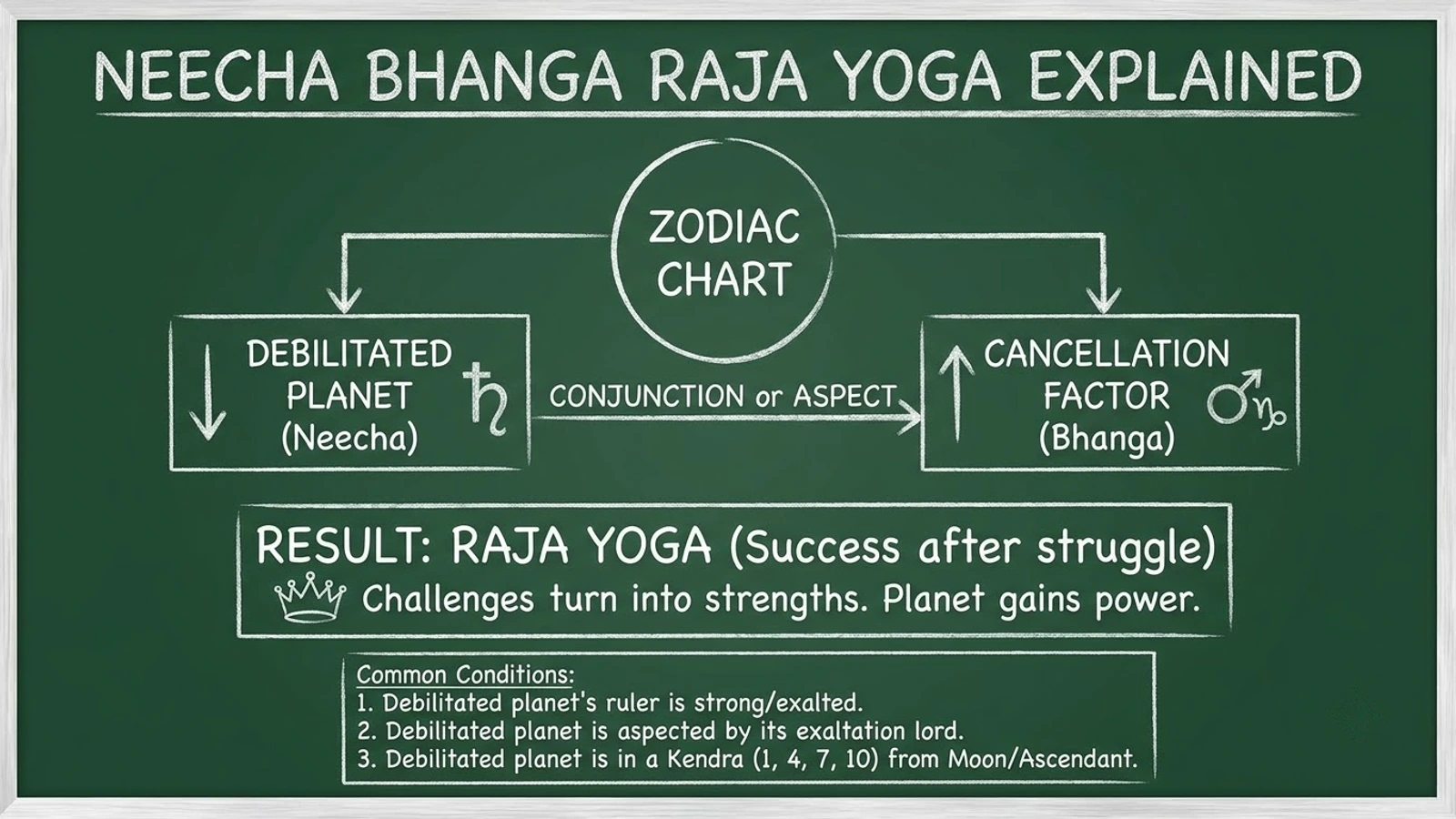
A debilitated planet has a reputation for being bad news. But Vedic astrology has always held space for the idea that a weakness, under the right conditions, can convert into a strength, and Neecha Bhanga Raja Yoga is the classical name for exactly that reversal.
What Is Neecha Bhanga?
Neecha Bhanga literally means "cancellation of debilitation", a set of specific classical conditions that, when present in a chart, are traditionally understood to cancel or substantially soften a planet's debilitated (neecha) state. See exalted and debilitated planets for what debilitation means on its own, before cancellation is considered.
What Is Neecha Bhanga Raja Yoga?
When the cancellation is strong enough, classical texts go a step further: rather than simply neutralising the weakness, the debilitated planet can become a source of significant strength, a Raja Yoga, traditionally linked to authority, success and elevated results. See Raj Yoga in Vedic astrology for how that broader category of combination works. Neecha Bhanga Raja Yoga is essentially a debilitation that flips all the way into a Raja Yoga, rather than merely being cancelled out.
Why Debilitation Doesn't Always Mean Weak Results
This is the core reason Neecha Bhanga matters: a debilitated planet's final reading in a chart was never meant to be read from sign placement alone. Its house placement, its relationship to other planets, and specific classical cancellation combinations can all soften, neutralise, or in stronger cases reverse the traditional weak reading of debilitation.
Classical Conditions for Debilitation Cancellation
Several distinct classical conditions can trigger Neecha Bhanga: a chart may meet one, several, or none of them.
The Dispositor Is Well-Placed
If the planet that rules the debilitated planet's sign is itself placed in a Kendra (angular house: the 1st, 4th, 7th or 10th) from the Lagna or from the Moon, this is one of the most commonly cited cancellation conditions.
The Lord of the Exaltation Sign Is Angular
If the ruler of the sign where the debilitated planet would be exalted is placed in a Kendra from the Lagna or Moon, this is traditionally read as another valid cancellation trigger.
Mutual Exchange (Parivartana) With the Dispositor
If the debilitated planet and its sign's dispositor are in mutual exchange, each sitting in the other's sign. This exchange is traditionally treated as a strong cancellation condition.
The Debilitated Planet Is Aspected by Its Exaltation Lord or Own-Sign Lord
A supportive aspect from the planet that would exalt or own-sign the debilitated planet is traditionally read as adding further cancellation strength.
Why Not Every Neecha Bhanga Becomes a Raja Yoga
Meeting one classical condition is meaningful, but it isn't automatically decisive on its own. The strength of the cancellation, and whether it rises to the level of a full Raja Yoga rather than a milder softening, depends on how many conditions are met, how strong the specific planets involved are elsewhere in the chart, and the debilitated planet's own house role.
The Importance of House Placement
A debilitated planet in a difficult house still carries some of that house's challenges even after cancellation. Neecha Bhanga changes the planet's underlying strength, not the house it happens to occupy.
The Importance of Planetary Strength
The dispositor and exaltation-lord planets involved in triggering the cancellation need their own reasonable strength for the cancellation to carry real weight: a cancellation "triggered" by planets that are themselves badly afflicted is traditionally read as weaker.
Dasha Activation
Like most chart potentials, a Neecha Bhanga Raja Yoga is traditionally understood to show its results most visibly when the relevant planet's Dasha or Antardasha is active. See how to read your Vimshottari Dasha.
Common Misunderstandings
Don't read this as a checklist where ticking one box lets you conclude "I have a Raja Yoga." That's exactly the oversimplification classical Jyotish warns against: interpretation depends on the complete chart: how many conditions are met, the strength of the planets involved, house placement, and dasha timing together, not any single condition read in isolation.
Frequently Asked Questions
Does Neecha Bhanga completely erase debilitation?
Traditionally it's read as cancelling or substantially modifying the debilitation's typical effects, rather than pretending the debilitation never happened: the planet's weakened sign placement is still part of its story, but the classical conditions that trigger Neecha Bhanga are believed to redirect the outcome, sometimes strongly enough to become a Raja Yoga.
If I have one Neecha Bhanga condition, do I automatically have a Raja Yoga?
Not necessarily. Meeting one classical condition is a meaningful signal, but the cancellation's actual strength still depends on the rest of the chart: the debilitated planet's house placement, its other aspects, and whether its dasha is positioned to activate the effect. A single condition in a weak chart context reads differently from the same condition in a well-supported one.
Which planets can have Neecha Bhanga?
Any of the seven classical planets that have a debilitation sign (Sun, Moon, Mars, Mercury, Jupiter, Venus and Saturn) can potentially have their debilitation cancelled if the classical conditions are met in that specific chart.
Check your own debilitated planets
Generate your free Kundli with Aroha Astrology to see whether any of your planets are debilitated, and whether the classical Neecha Bhanga conditions apply in your specific chart.