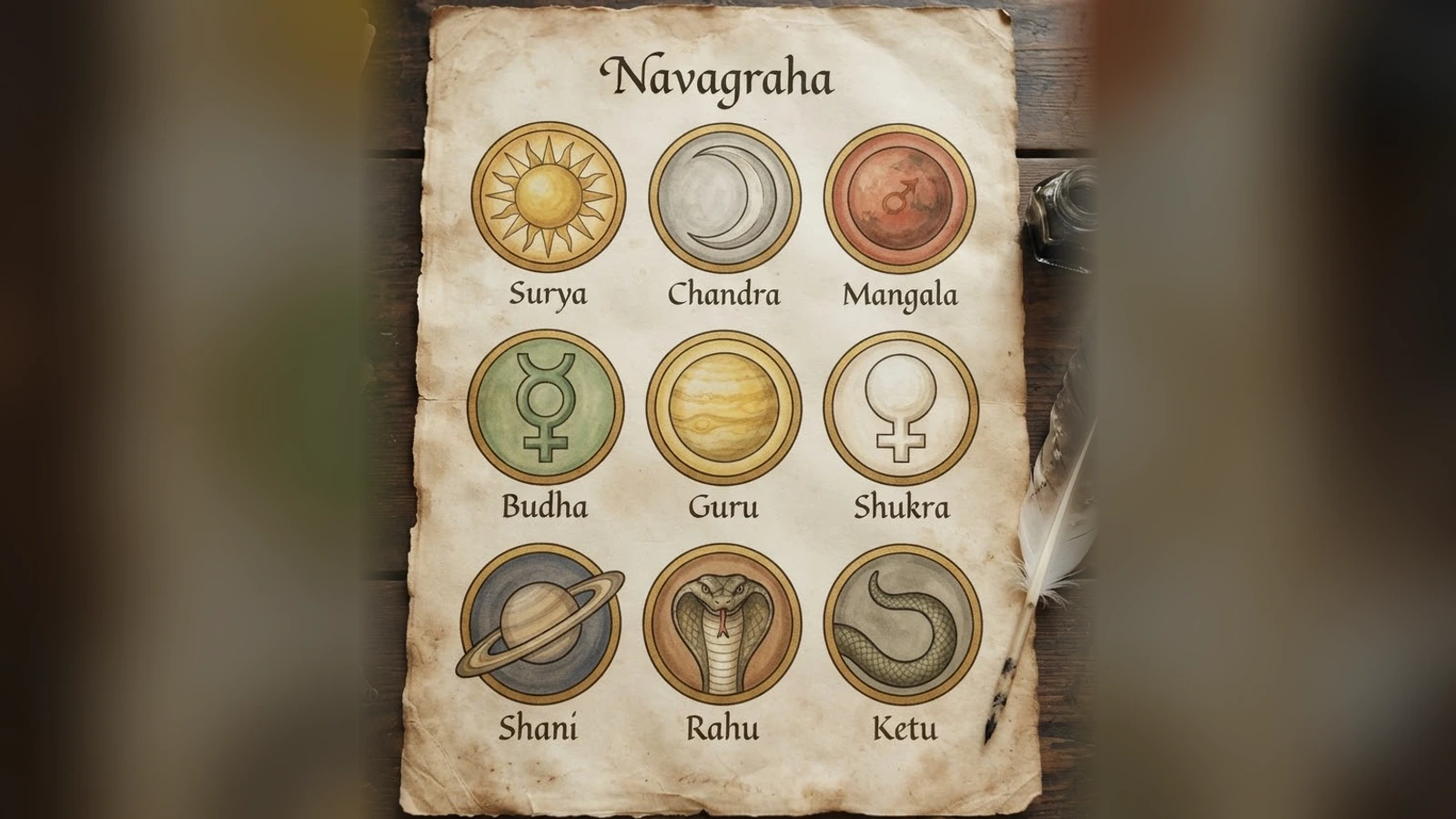
Vedic astrology, or Jyotish, builds its entire predictive system around nine bodies known as the Navagraha, literally, the "nine seizers" or nine planetary influences. Two of them, Rahu and Ketu, aren't physical planets at all; they're the lunar nodes, the points where the Moon's orbit crosses the Sun's apparent path. Jyotish treats all nine as Grahas because all nine are understood to exert a gravitational-style pull on a person's life, not because of a literal astronomy claim.
Surya: Sun
Vitality, authority, confidence and leadership. The Sun is also traditionally read as significator of the father and of one's core sense of self.
Chandra: Moon
The mind, emotions, and the mother. Where the Sun represents your identity, the Moon represents your inner world: how you feel and react moment to moment.
Mangal: Mars
Courage, energy, competition and decisive action. Mars is the planet of drive: the willingness to push forward and take on a fight.
Budha: Mercury
Communication, intelligence, business acumen and analytical ability. Mercury governs how you think, speak and process information.
Guru: Jupiter
Wisdom, knowledge, expansion and teachers. In classical Jyotish, Jupiter is generally regarded as the most benefic of the nine, associated with growth, higher learning and good fortune.
Shukra: Venus
Relationships, beauty, luxury and creativity. Venus governs attraction, aesthetics and what you find pleasurable.
Shani: Saturn
Discipline, responsibility, delays and perseverance. Saturn has a reputation as astrology's "hard teacher", but its themes are really about structure, patience and long-term results earned through consistent effort.
Rahu
Ambition, unconventional experiences and material desire. As a lunar node rather than a physical body, Rahu is traditionally read as an intensifier, amplifying whatever house and sign it occupies, often in ways that pull a person outside convention.
Ketu
Detachment, spirituality and introspection. Where Rahu pulls toward worldly ambition, Ketu, its opposite node, pulls toward release, inward focus and matters beyond the material.
Why all nine matter together
No single Graha is read in isolation. A chart's overall character comes from how these nine interact: their house placements, their strength, whether any of them are combust, the aspects between them, and the periods (Dashas) they rule over the course of a life. Learning what each one governs is the first step toward reading your own chart as a whole rather than one placement at a time.
Find your Navagraha placements
Generate your free Kundli with Aroha Astrology to see exactly where all nine Grahas sit in your own birth chart.