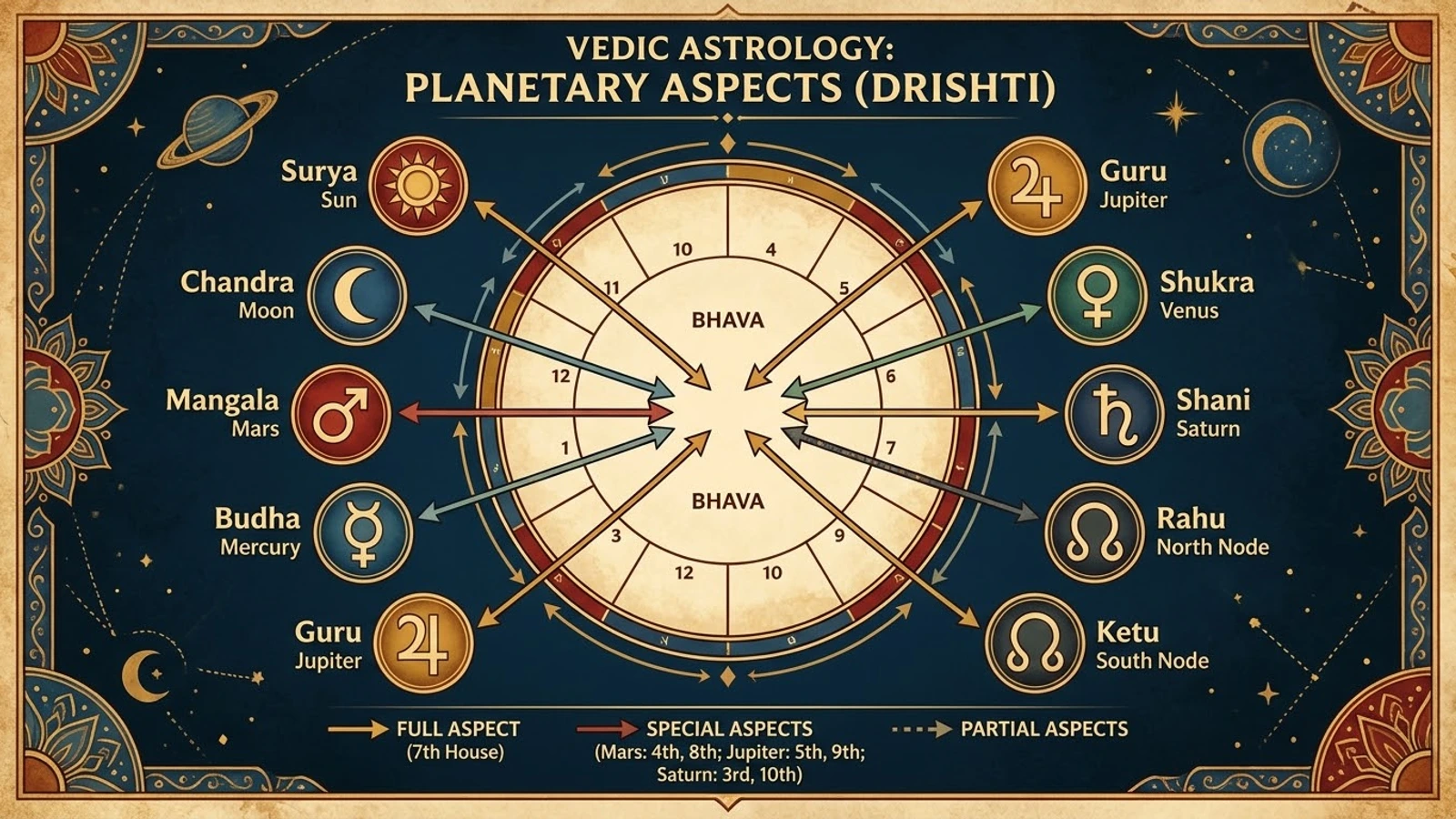
Two planets don't need to sit in the same house to influence each other. Vedic astrology reads a planet's reach through drishti, its aspect, and understanding this is what turns a list of house placements into an actual chart reading.
What Is a Drishti?
Drishti, literally "sight" or "glance," describes a planet's traditional influence on a house or planet other than its own. The classical language for it is that the aspecting planet "sees" the aspected position.
How Planetary Aspects Work
Aspects are counted by house position from the aspecting planet, not by physical distance or degree alone. Every graha carries the same baseline aspect; some planets additionally carry extra, "special" aspects that reach further.
This whole-sign, house-counted aspect system is the Parashari approach, the one most commonly taught and most widely used. Other schools of Jyotish, notably Jaimini and the Krishnamurti Paddhati (KP) system, use different aspect logic entirely, including degree-based rather than whole-house aspects in KP. This guide covers the Parashari system specifically, not a universal rule shared by every tradition.
The Universal 7th Aspect
Every planet aspects the house directly opposite its own: the 7th house counted from wherever it sits. This is the one rule that holds for all seven classical grahas without exception, and it's the foundation the special aspects below are added on top of.
Jupiter's Special Aspects
Jupiter carries its 7th aspect like every planet, plus two additional special aspects on the 5th and 9th houses from itself, reflecting its traditional role as the most benefic, wisdom-and-growth-oriented graha, with an unusually wide reach across the chart.
Mars's Special Aspects
Mars carries its 7th aspect plus special aspects on the 4th and 8th houses from itself: houses traditionally linked to home/property and transformation/crisis respectively, consistent with Mars's more forceful, action-oriented character.
Saturn's Special Aspects
Saturn carries its 7th aspect plus special aspects on the 3rd and 10th houses from itself, the 10th being particularly significant, since it means Saturn's discipline-and-delay signature reaches directly into career matters from three houses away, not only from a 7th-house placement.
Rahu and Ketu Aspects: Why Traditions Differ
This is a genuine point of disagreement between schools, not a settled rule. Some traditions assign Rahu and Ketu the same special aspects as Jupiter and Mars respectively (on the reasoning that the nodes "borrow" character from those planets); others apply only the standard 7th aspect to the nodes, or a different scheme again. If you see conflicting explanations of node aspects across different sources, that's why: there isn't one universally agreed answer here the way there is for Mars, Jupiter and Saturn.
Aspects vs. Conjunctions
A conjunction is two or more planets physically sharing the same house: their influences blend directly. An aspect is a planet influencing a different house from a distance, without being placed there itself. Both matter, and a full chart reading accounts for each separately: what's conjunct a planet, and what's aspecting it.
How to Read Multiple Aspects on One House
A single house can receive aspects from several planets at once, each adding its own character. A house aspected only by benefics (like Jupiter) reads very differently from the same house aspected primarily by malefics (like Saturn or Mars), and a house receiving both benefic and malefic aspects together needs the full combination weighed, not just a tally of "good" versus "bad" influences.
Planetary Strength and Aspect Strength
An aspect from a strong, well-placed planet in good dignity carries more traditional weight than the same aspect from a weak, debilitated or combust one. See exalted and debilitated planets and combust planets for how a planet's own condition is judged before weighing what it aspects.
Frequently Asked Questions
What is drishti in Vedic astrology?
Drishti means a planet's aspect, its traditional ability to influence a house or planet other than the one it's sitting in, described as the planet "seeing" that other position. Every graha carries a full aspect on the 7th house from itself, and Mars, Jupiter and Saturn carry additional special aspects.
Do Rahu and Ketu have aspects?
This is one of the points where traditions genuinely disagree. Some schools give the nodes the same aspects as Jupiter and Mars respectively, or the standard 7th aspect all planets share; others treat them differently again. There's no single universally agreed rule here, unlike the aspects of Mars, Jupiter and Saturn.
Is an aspect the same as a conjunction?
No. A conjunction is two or more planets occupying the same house together; an aspect is a planet influencing a different house or planet from a distance, without being physically placed there. They're related but distinct mechanisms, and a chart is read using both.
See the aspects in your chart
Generate your free Kundli with Aroha Astrology to see which planets aspect your houses, and how those aspects factor into your reading.