Search "astrology remedies" and you'll mostly find generic lists: wear this gem, chant this mantra, donate on this day. Classical Jyotish treats remedies (upay) as something matched to a specific chart, not a one-size-fits-all shopping list. Below are the traditional remedy categories, and where the generic-advice approach falls short.
What Are Vedic Astrology Remedies?
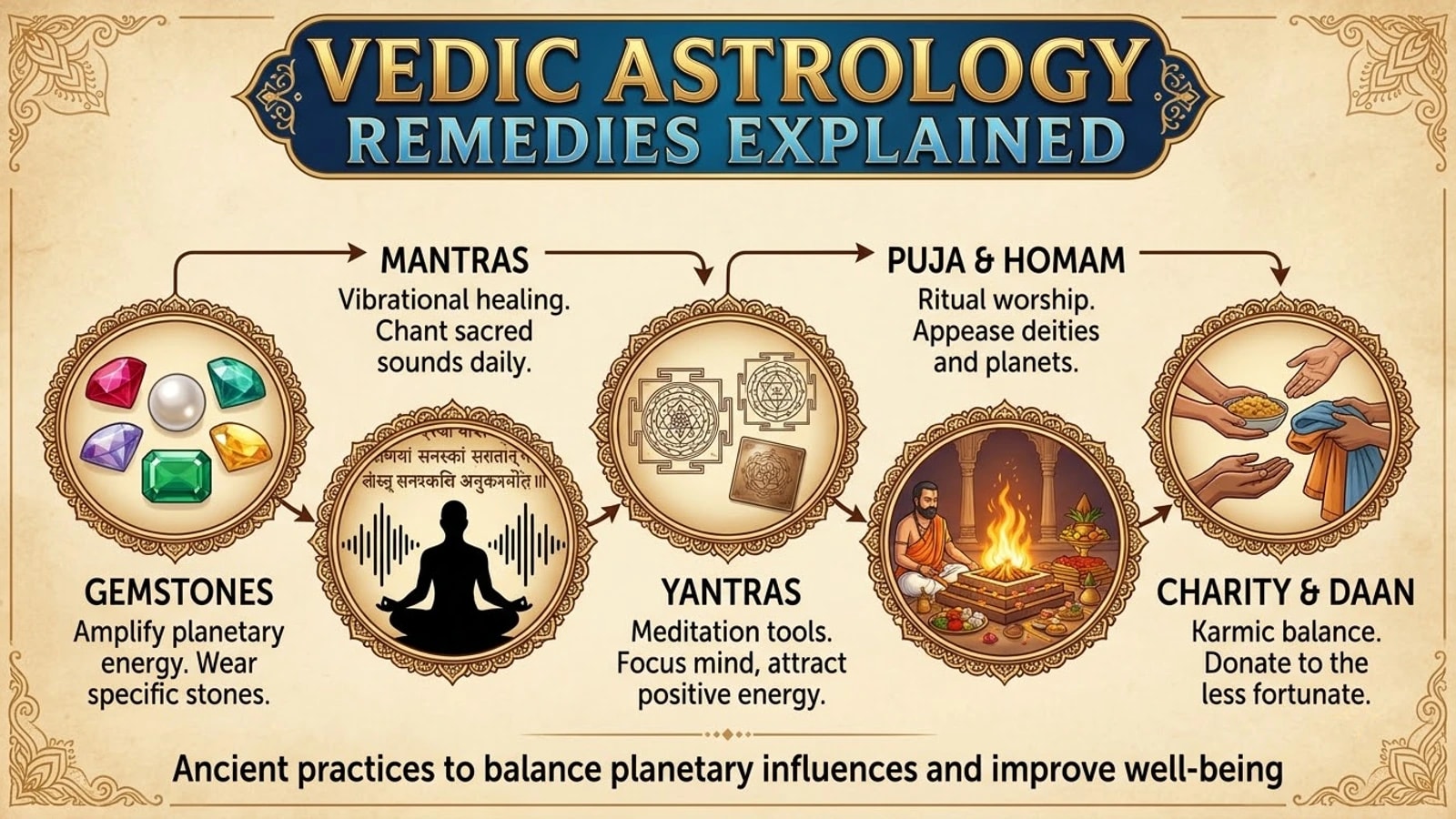
Upay, commonly translated as remedies, are traditional practices (mantra, charity, fasting, worship, gemstones, yantras and others) associated in classical texts with easing the expression of a difficult planetary placement or supporting a favourable one.
Why Are Remedies Recommended?
The underlying idea is that a planet's difficult placement in a chart isn't necessarily fixed and unchangeable. Traditional practice offers ways to work with that placement rather than simply accept it passively.
Mantra and Japa
Repeated chanting of a planet-specific mantra, Japa, is one of the most widely practiced remedies, generally tied to a specific count and a planet-appropriate mantra rather than a generic one.
Charity and Donation
Dāna, giving associated with a specific planet's traditional correspondences (particular items, particular days), is a long-standing remedy category, often paired with fasting or worship on the same planet's associated day.
Fasting and Vrat
Fasting on a day associated with a specific planet (Saturday for Saturn, Tuesday for Mars, and so on) is a traditional practice believed to support that planet's more favourable expression.
Puja and Worship
Formal worship directed at a deity associated with a specific planet is a traditional remedy category of its own, distinct from mantra recitation, though the two are often practiced together.
Gemstones
Specific gemstones are traditionally associated with specific planets. See how Vedic astrology recommends gemstones for how that Navaratna system works, and why verifying a stone's authenticity matters as much as choosing the right one.
Yantras
Geometric diagrams, yantras, associated with specific planets or deities are another traditional remedy category, generally used alongside mantra or worship rather than as a standalone practice.
Temple Visits
Visiting a temple associated with a planet's presiding deity, particularly on that planet's associated day, is a widely practiced remedy in many regional traditions.
Behavioural and Ethical Remedies
Beyond ritual practices, classical texts also describe behavioural remedies: cultivating specific virtues or avoiding specific behaviours associated with a planet's more difficult expression, treated as complementary to, not a replacement for, the ritual categories above.
How Remedies Are Traditionally Chosen
Selection is meant to start from the actual chart: which planet needs support, its house role, its dignity, and what's realistically appropriate for the individual, not a generic "top 10 remedies" list applied without reference to the chart at all.
Why a Remedy Should Match the Chart
A remedy chosen for a planet that's already well-placed and strong in a chart isn't targeting the same need as the identical remedy chosen for a severely afflicted placement of the same planet in someone else's chart. Matching the remedy to the actual chart context is a core part of traditional practice, not an optional refinement.
Can a Remedy "Cancel" a Planet Completely?
Traditional framing generally treats remedies as supporting or easing a placement, not erasing it outright. That's worth distinguishing from a genuine chart-based cancellation condition, like Neecha Bhanga, which works through the chart's own combinations rather than an external remedial practice. The two are related in spirit: both speak to a difficult placement not being the final word, but they're not the same mechanism.
Common Misconceptions
- "One remedy fixes everything": remedies are traditionally chart-specific and planet-specific, not universal fixes.
- "A more expensive gemstone is automatically more effective": traditional selection criteria centre on the stone matching the right planet and being genuine, not on price.
- "Remedies replace effort": classical framing generally treats remedies as support alongside effort, not a substitute for it.
Frequently Asked Questions
Do Vedic astrology remedies work the same way for everyone?
No. A core principle behind traditional remedy selection is that it should match the specific chart it's for. A remedy chosen for one person's Saturn placement isn't automatically appropriate for someone else's, even if both charts mention Saturn as a concern.
Can a remedy completely cancel a difficult planetary placement?
Traditional framing generally describes remedies as supporting or easing a placement's expression, not erasing the placement itself. That's a different claim from something like Neecha Bhanga, which is a chart-based cancellation condition rather than a remedial practice: remedies and cancellations aren't the same mechanism.
Do I need a gemstone to fix a weak planet?
No. Gemstones are one traditional remedy category among several (mantra, charity, fasting, puja, yantras, behavioural practices), and classical texts don't treat them as mandatory or as the only valid option. Authenticity and correct selection matter more than defaulting to a gemstone by habit.
See what your own chart suggests
Generate your free Kundli with Aroha Astrology to see which of your planets are under strain, as a starting point for exploring remedies that are actually matched to your chart.