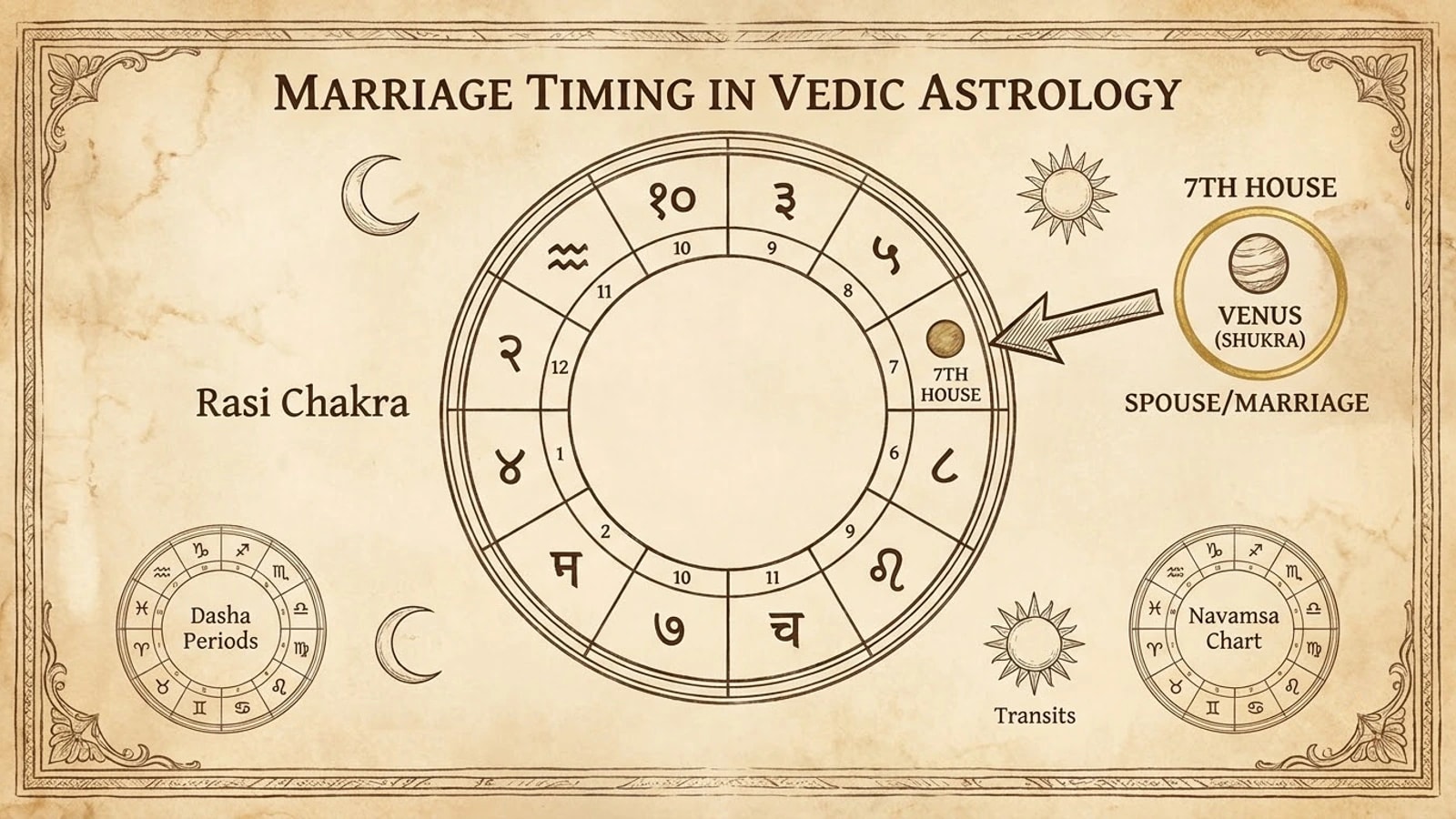
"When will I get married?" is one of the most-asked questions in any astrology consultation, and one where the answer is more nuanced than a single date. The rest of this guide covers how the analysis works and why it should be read as a study of likely periods rather than a prediction of an exact day.
Can Vedic Astrology Predict Marriage Timing?
Not with the precision the question often implies. What traditional analysis offers is a way of identifying likely windows: periods where multiple chart factors point toward marriage becoming more probable, rather than a single guaranteed date. Be cautious of any claim that promises an exact date; that's not what the classical method is built to do.
Why the 7th House Matters
The 7th house is the primary house of partnership and marriage in Vedic astrology, the house opposite the Lagna, traditionally read as governing committed relationships specifically. See the 12 houses explained for where it sits among the others.
The 7th Lord
The planet ruling the 7th house, the 7th lord, carries much of the marriage story. Its strength, dignity, house placement and aspects shape how, and often roughly when, marriage themes activate in the chart.
Venus and Marriage
Venus, the natural significator of relationships, love and marriage, is read for both men's and women's charts as a general marriage indicator, independent of the 7th house's own condition: its dignity and placement add another layer to the analysis.
Jupiter and Marriage
Jupiter carries particular weight in this analysis, especially in traditional readings of women's charts, as a signifier of the husband and of marital fortune more broadly: its strength and placement are read alongside Venus and the 7th house.
The Role of the 2nd and 11th Houses
The 2nd house (family, accumulated relationships) and the 11th house (fulfilment of desires, gains) are traditionally read as supporting houses for marriage timing: a well-supported 2nd and 11th alongside a strong 7th house is generally read as more favourable than the 7th house considered alone.
Navamsa (D9) and Marriage
The Navamsa, or D9 chart, is specifically associated with marriage and partnership in classical Jyotish. See divisional charts and the Navamsa. A 7th house and 7th lord that look only moderately supported in the main chart (D1) can show a stronger marriage indication in the D9, and vice versa; both are read together.
Dashas and Marriage Timing
Marriage timing is traditionally linked to the Dasha or Antardasha of a marriage-significant planet becoming active: the 7th lord, Venus, or Jupiter, depending on the chart. See how to read your Vimshottari Dasha and Mahadasha, Antardasha and Pratyantar Dasha explained for how that timing hierarchy works.
How Transits Are Used
Alongside Dasha, transits (Gochar) of Jupiter and Venus over key chart points, particularly the 7th house or its lord, are traditionally treated as a secondary confirming or triggering factor within an already-supportive Dasha window, rather than a stand-alone timing method on their own. See planetary transits explained.
Why Different Charts Can Show Different Timing
Two people with a similarly placed 7th house can still have very different marriage timing, because the Dasha sequence, the Navamsa placement, and the transit picture are all individually specific to each birth chart: the 7th house alone was never meant to be read in isolation.
Marriage Delay: What Does It Actually Mean?
Certain traditional combinations are read as indicating delay relative to what's typical, rather than denial. A "delayed marriage" indicator in classical reading generally means later-than-average timing, still shaped by the same web of factors above, not an indicator that marriage won't happen.
Why One Placement Cannot Predict Marriage
The 7th house, its lord, Venus, Jupiter, the 2nd and 11th houses, the Navamsa, Dasha timing and transits are all part of one synthesis, not independent verdicts. A single strong or weak factor read alone will mislead more than it informs, which is exactly why "when will I get married" resists a one-line answer.
Frequently Asked Questions
Can Vedic astrology tell me my exact marriage date?
No, and be wary of anyone who claims it can. What it offers is an analysis of likely periods, based on the 7th house, its lord, Venus, Jupiter, the Navamsa chart, and Dasha timing together: a window of favourable timing, not a single predicted date.
Why do different astrologers give different marriage timing for the same chart?
Because the analysis synthesises several independent factors (house strength, planetary dignity, divisional charts, Dasha, and transits) and different astrologers can reasonably weigh those factors differently, or place more emphasis on one method (like Dasha timing) over another (like transits).
Does a delayed 7th house mean marriage won't happen?
No. A traditionally interpreted "delay" indicator generally points to timing later than average, not an absence of marriage altogether, and it's read alongside the rest of the chart, not as a standalone verdict.
See your marriage indicators
Generate your free Kundli with Aroha Astrology to see your 7th house, Venus, Jupiter and Navamsa placements together, with a plain-language explanation of how they connect to your Dasha timeline.